

The COVID 19 cicada variant is real, but it isn’t a bug-related illness and it isn’t an internet joke. It’s BA.3.2, an Omicron subvariant that picked up a catchy nickname and, with it, a lot of confusion.
The name stuck because BA.3.2 appears to have re-emerged from an older branch after a long quiet stretch. If recent headlines felt odd or alarmist, the facts are simpler. This is another form of SARS-CoV-2, and experts are watching it for spread, symptoms, and risk.
You don’t need hype. You need a clear read on what it is, where it showed up, what symptoms fit, and what current health updates mean for daily life.
What the COVID 19 cicada variant is, and why experts are watching it
BA.3.2 belongs to the Omicron family. As of late March 2026, it has been tracked in the US and in several other countries. In the US, it still appears uncommon overall. Still, health officials are paying attention because it has turned up in wastewater, traveler screening, airplane wastewater, and routine patient testing across multiple states. The CDC’s BA.3.2 surveillance report gives the clearest public snapshot so far.
The World Health Organization has placed BA.3.2 in the “variant under monitoring” group. That label matters, but not in a scary way.
Variant under monitoring” means experts see signals worth tracking, not that a major new threat has been proven.
In other words, BA.3.2 is on the radar because it looks different enough to study closely. So far, that doesn’t mean it has been shown to cause a worse global wave.
Why it is called the cicada variant
“Cicada” is an informal nickname, not a scientific label. News coverage and social posts likely pushed it forward because BA.3.2 seems tied to an older BA.3 branch that went quiet and then came back into view. Like a cicada emerging after a long pause, the image was easy to remember, so it spread fast.
That nickname helps people recognize the story, but it can also mislead. BA.3.2 is still just a subvariant of the coronavirus.
Where BA.3.2 came from and how it spread
Researchers first identified BA.3.2 in South Africa in late 2024. During 2025 and early 2026, detections expanded to the US, Europe, and Australia. Europe has seen faster growth than the US, while American surveillance has found scattered signals in many states rather than one clear nationwide surge.
What makes BA.3.2 different from other recent COVID strains

What stands out about BA.3.2 is its mutation pattern, not proven higher severity. Scientists have focused on its spike protein changes because that part of the virus helps it enter cells and also shapes how the immune system recognizes it. The WHO risk evaluation for BA.3.2 says current vaccines are still expected to help protect against severe disease.
The mutation count sounds alarming, but context matters
BA.3.2 has more than 50 spike mutations compared with close relatives, and more than 70 compared with the original Wuhan strain. On paper, that sounds dramatic. In practice, mutation counts alone don’t tell the whole story.
Some changes matter a lot. Others don’t do much. That’s why scientists look at lab testing, case patterns, hospital impact, and outcomes in real people, not just a long list of genetic edits. A virus can look strange in a sequence report and still behave much like other recent strains in daily life.
Can it spread faster or dodge immunity better
Early evidence suggests BA.3.2 may have a growth edge in some places, and it may slip past part of the immune protection from prior infection or vaccination. That helps explain why agencies are watching it so closely.
Still, the key point is steady: immune escape does not mean immune failure. Protection from vaccines and prior exposure may be weaker against infection itself, but it still appears to offer some defense, especially against severe illness. Right now, there is no clear proof that BA.3.2 causes more serious disease than other recent COVID strains.
Symptoms, current risk, and what to do if cases rise near you
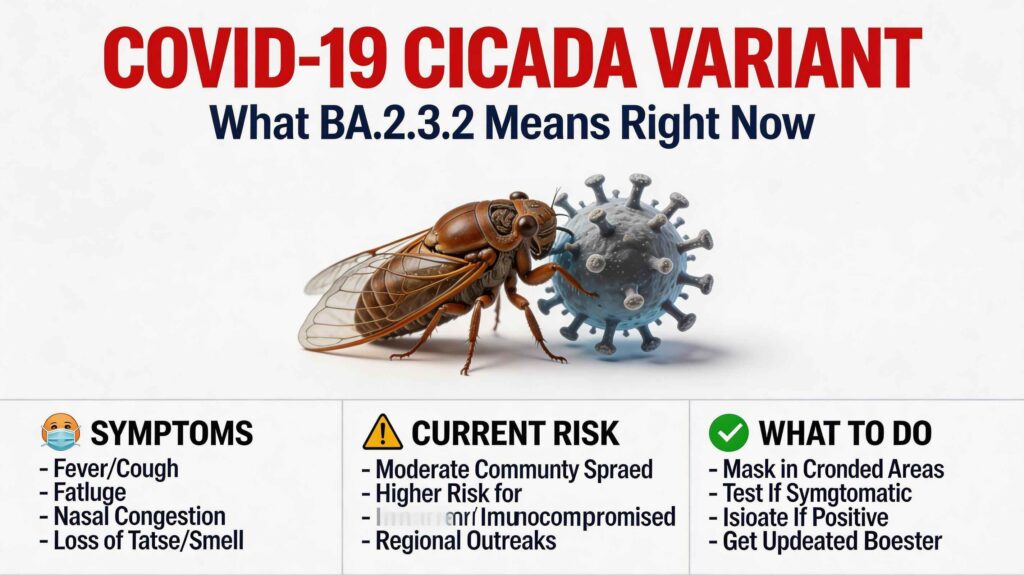
For most people, symptoms linked to BA.3.2 look a lot like other recent COVID infections. That’s part of why the nickname grabs attention more than the symptoms do. Older adults, immunocompromised people, and anyone with major health conditions still face the highest risk if infections rise nearby. A recent PBS summary of what we know so far also points to symptoms and severity that look familiar rather than unusual.
Common symptoms linked to the COVID 19 cicada variant
Common symptoms reported with BA.3.2 include:
- Runny or stuffy nose, often like a mild cold
- Headache, which may come early
- Fatigue, sometimes out of proportion to other symptoms
- Sneezing, especially with upper-respiratory symptoms
- Sore throat, often mild to moderate
- Cough, dry or loose
- Changes in taste or smell, though less often than earlier in the pandemic
So far, nothing suggests BA.3.2 causes a unique symptom pattern.
Simple steps to protect yourself and others
The best response is simple and boring, which is good news. If cases rise in your area, fall back on habits that still work.
- Stay up to date on vaccines if you’re eligible
- Test when you feel sick, especially before visiting high-risk people
- Improve indoor airflow, because cleaner air lowers spread indoors
- Rest at home early when symptoms start
- Ask for medical advice quickly if you’re high-risk or symptoms worsen
Also watch local wastewater trends and health department updates. Those signals can show a rise before headlines catch up. Panic doesn’t help, but awareness does.
The noisy nickname made BA.3.2 sound stranger than it is. The core facts are steady: it’s a real subvariant, experts are monitoring it, symptoms look much like other recent strains, and there is still no solid proof that it causes worse illness.
Keep following trusted health updates and use common-sense precautions when cases climb near you. Calm awareness beats panic every time.
FAQs
What is the COVID 19 cicada variant (BA.3.2)?
The COVID 19 cicada variant refers to BA.3.2, a subvariant of the COVID 19 virus within the Omicron variant family. The term “cicada” is just a nickname and not a scientific classification.
Why is it called the “cicada variant”?
The name comes from the idea that BA.3.2 reappeared after a long period of low activity, similar to how cicadas emerge after years underground. It’s a media-driven nickname, not an official term.
Is BA.3.2 more dangerous than previous variants?
Current evidence does not show that BA.3.2 causes more severe illness than other Omicron subvariants. Health experts are monitoring it, but there’s no confirmed increase in severity.
Does the BA.3.2 variant spread faster?
Early observations suggest BA.3.2 may have a slight growth advantage in some regions, meaning it could spread more easily, but this is still being studied.
Can BA.3.2 evade vaccines or immunity?
BA.3.2 may partially evade immunity from past infection or vaccination. However, vaccines still provide important protection against severe disease and hospitalization.
What are the common symptoms of the cicada variant?
Common symptoms include a runny or stuffy nose, headache, fatigue, sore throat, cough, and sometimes mild fever. These are similar to other recent COVID 19 infections.
Does BA.3.2 cause unique or unusual symptoms?
No, there is no evidence that BA.3.2 causes new or unusual symptoms. It behaves similarly to other recent COVID 19 variants.
Who is most at risk from this variant?
Older adults, people with weakened immune systems, and those with underlying health conditions remain at higher risk if infected.
How can you protect yourself from BA.3.2?
Stay up to date with vaccinations, test if you feel sick, maintain good indoor ventilation, avoid close contact when symptomatic, and follow local health guidance.
Should you be worried about the cicada variant?
There’s no need for panic. BA.3.2 is being monitored, but there’s no solid evidence that it poses a greater threat than recent variants. Staying informed and following basic precautions is enough.