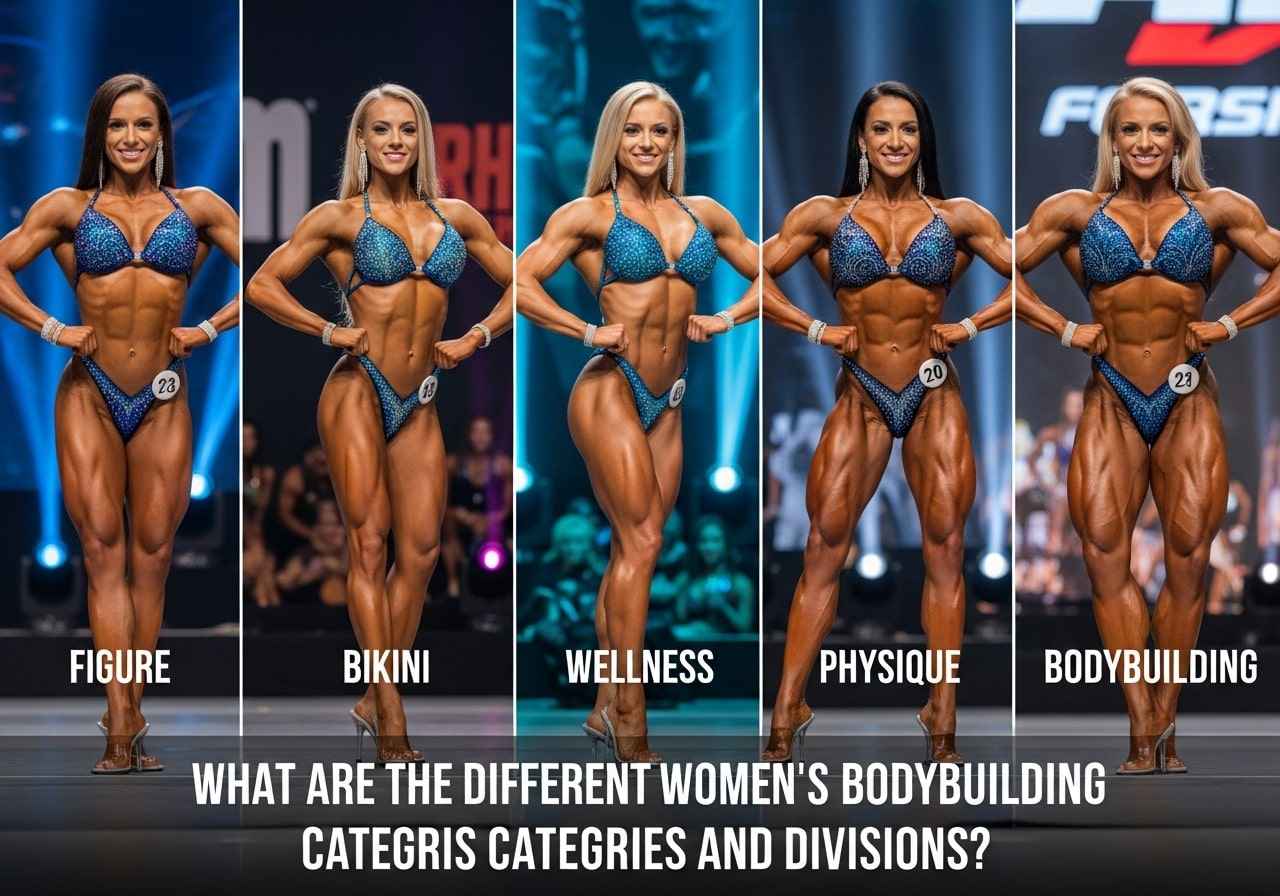
Women’s bodybuilding offers multiple competitive pathways, each with distinct requirements for physique development, posing, and presentation. This guide breaks down the different women’s bodybuilding categories and divisions for aspiring competitors, current athletes, and fitness enthusiasts who want to understand competitive standards.
You’ll discover the major divisions, including Figure, Physique, Bikini, and Wellness categories that define modern women’s bodybuilding competition. We’ll also cover how judging criteria and posing requirements vary between each division, plus practical advice for choosing the right category based on your body type and training goals.
Women’s Bodybuilding Categories Explained for Competitive and Recreational Athletes

What are women’s bodybuilding categories and how they are classified
Women’s bodybuilding categories represent distinct competitive divisions that cater to different physique goals, muscle development levels, and aesthetic preferences. These categories of women’s bodybuilding are primarily classified based on muscle mass, definition, conditioning, and overall presentation style. The classification system creates opportunities for women with varying body types and training backgrounds to compete fairly against others with similar physique characteristics.
The primary classification factors include muscle size and density, body fat percentage, symmetry, proportion, and stage presentation requirements. Each category demands specific training approaches, nutritional protocols, and posing techniques. Women’s bodybuilding divisions range from the most muscular traditional bodybuilding category to the more mainstream-appealing bikini division, with figure, physique, and wellness categories filling the spectrum between these extremes.
Modern classification systems recognize that women’s bodies respond differently to training stimuli and that competitive success shouldn’t be limited to one narrow physique ideal. This diversity in women’s bodybuilding categories allows athletes to pursue their genetic potential while competing in divisions that reward their particular strengths and physique characteristics.
How women’s bodybuilding divisions differ based on muscle size and symmetry
The fundamental differences between women’s bodybuilding divisions center on acceptable muscle mass levels and specific symmetry requirements. Traditional women’s bodybuilding celebrates maximum muscle development with exceptional conditioning, similar to men’s bodybuilding but scaled appropriately for female physiques. Athletes in this division display significant muscle mass, extreme definition, and pronounced muscle separation.
Women’s physique sits as the next tier, requiring substantial muscle development but with slightly less mass than traditional bodybuilding. Physique competitors maintain excellent conditioning while presenting a more balanced approach to muscle size. The judging criteria emphasize muscle quality, symmetry, and overall flow rather than pure mass.
Figure competitors present moderate muscle development with excellent shape and conditioning. The focus shifts toward creating an athletic, fit appearance with good muscle tone and definition without excessive size. Symmetry plays a crucial role, with judges looking for balanced development across all muscle groups and pleasing proportional relationships.
Bikini division represents the most mainstream category, emphasizing shape, tone, and overall presentation rather than significant muscle mass. Competitors display athletic conditioning with subtle muscle definition, focusing on creating an appealing silhouette with balanced proportions and excellent stage presence.
Wellness category bridges the gap between figure and bikini, allowing for more lower body development, particularly in the glutes and legs, while maintaining a smaller upper body. This division recognizes that many women naturally carry more muscle mass in their lower bodies and celebrates this physique type.
Categories of women’s bodybuilding recognized in major competitions
Major bodybuilding organizations like the IFBB Pro League and National Physique Committee (NPC) officially recognize five primary women’s bodybuilding categories. These divisions have evolved over decades to accommodate the diverse range of female physique goals and genetic variations within the sport.
Traditional Women’s Bodybuilding remains the original and most muscular division, though participation has declined in recent years. This category requires maximum muscle development, exceptional conditioning, and displays the full spectrum of bodybuilding poses including mandatory poses like front double biceps, side chest, and rear lat spread.
Women’s Physique emerged as a bridge between traditional bodybuilding and figure, allowing significant muscle development while maintaining feminine lines. Competitors present in posing suits and perform quarter turns rather than mandatory poses, with judging focused on muscle quality, symmetry, and overall conditioning.
Figure Division represents one of the most popular categories, requiring moderate muscle development with excellent conditioning and shape. Athletes compete in two-piece suits and present through quarter turns, with emphasis on creating an athletic, fit appearance that appeals to mainstream audiences.
Bikini Division focuses on overall shape, tone, and presentation rather than muscle mass. Competitors wear decorative bikinis and present in a more relaxed, model-like manner. Success in this division depends heavily on genetics, conditioning, and stage presence rather than significant muscle development.
Wellness Division specifically celebrates lower body development while maintaining proportionate upper bodies. This newer category recognizes body types that naturally carry more muscle in the glutes and legs, providing competitive opportunities for athletes who don’t fit traditional figure or bikini proportions.
Different female bodybuilding categories and who they are designed for
Each female bodybuilding category attracts different athlete types based on genetic predispositions, training preferences, and physique goals. Understanding these target demographics helps potential competitors identify their most suitable division and develop appropriate preparation strategies.
Women’s bodybuilding appeals to athletes who respond exceptionally well to resistance training and can develop significant muscle mass naturally. These competitors typically have favorable genetics for muscle growth, enjoy intense training protocols, and are comfortable with substantial muscle development. Many former athletes from strength sports transition successfully into this division.
Women’s physique suits athletes seeking substantial muscle development without the extreme conditioning requirements of traditional bodybuilding. This category works well for women with good muscle-building genetics who prefer a slightly softer look while still showcasing impressive muscular development and athletic conditioning.
Figure division attracts women who build muscle moderately well and can achieve excellent conditioning without excessive difficulty. This category appeals to former athletes, fitness enthusiasts, and women who want to showcase an athletic physique without extreme muscle mass. Figure competitors often come from backgrounds in team sports, dance, or general fitness training.
Bikini division welcomes women with naturally athletic builds who may not build significant muscle mass easily. Success often depends more on genetics, natural shape, and presentation skills rather than years of intense training. Many models, dancers, and fitness enthusiasts find success in this division.
Wellness category specifically targets women with naturally curvier lower bodies who build muscle easily in their glutes and legs but maintain smaller upper bodies. This division celebrates body types that might struggle to fit traditional figure or bikini standards, providing a competitive home for athletes with these genetic characteristics.
Women’s bodybuilding categories explained for beginners entering the sport
Beginners entering women’s bodybuilding should carefully evaluate their genetic predispositions, training responses, and long-term physique goals before selecting a competitive category. The decision significantly impacts training protocols, nutritional strategies, and timeline expectations for competitive readiness.
New competitors should honestly assess their natural body type, muscle-building potential, and conditioning abilities. Women who build muscle easily and enjoy intense training might gravitate toward physique or traditional bodybuilding, while those who prefer maintaining a softer, more athletic look might find success in figure or bikini divisions. Wellness provides an excellent option for women with naturally curvier lower bodies.
Training background also influences category selection. Former strength athletes, powerlifters, or CrossFit competitors often transition well into physique or bodybuilding divisions due to their muscle-building foundation. Dancers, models, or general fitness enthusiasts might find the bikini or figure more suitable starting points.
The time investment required varies significantly between categories. Bikini competitors might achieve stage readiness in 12-16 weeks with proper guidance, while physique or bodybuilding competitors often require years of dedicated muscle-building before their first competition. Understanding these timelines helps beginners set realistic expectations and develop appropriate preparation strategies.
Cost considerations include posing suits, tanning, hair, makeup, and coaching expenses that vary between divisions. Bikini suits can cost several hundred dollars and require specific styling, while physique and bodybuilding divisions have different presentation requirements and associated costs.
Most importantly, beginners should choose categories that align with their natural strengths and long-term goals rather than trying to force their bodies into unsuitable divisions. Success comes from maximizing genetic potential within the most appropriate competitive framework rather than fighting natural tendencies to fit predetermined ideals.
Major Women’s Bodybuilding Divisions in Professional and Amateur Competitions

Women’s bodybuilding divisions commonly seen in professional competitions
Professional women’s bodybuilding competitions feature five primary divisions that showcase different physique aesthetics and muscle development levels. The Bodybuilding division represents the most muscular category, where competitors display maximum muscle mass, definition, and conditioning. Athletes in this division possess significant muscle size comparable to their male counterparts, with judges evaluating symmetry, proportion, and overall muscular development.
The Figure division emphasizes a balanced, athletic physique with moderate muscle development. Competitors showcase lean muscle mass without the extreme conditioning required in bodybuilding, presenting a more mainstream appeal while maintaining impressive strength and definition. This category bridges the gap between fitness modeling and competitive bodybuilding.
Bikini competitors focus on shape, tone, and overall presentation rather than muscle mass. This division prioritizes a fit, healthy appearance with subtle muscle definition, making it accessible to women seeking competitive bodybuilding without extreme muscle development. The emphasis lies on balance, flow, and feminine curves.
Women’s Physique sits between Figure and Bodybuilding, featuring more muscle mass than Figure but less than traditional Bodybuilding. Competitors display impressive muscle development with clear separation and conditioning while maintaining feminine lines and proportions.
The newest addition, Wellness, celebrates lower body development with emphasis on glute and leg muscularity while maintaining a smaller upper body. This division recognizes the growing popularity of curves and celebrates different body types within competitive bodybuilding.
IFBB women’s bodybuilding categories and their judging focus
The International Federation of Bodybuilding and Fitness (IFBB) sets global standards for women’s bodybuilding competition categories, establishing specific judging criteria for each division. In the IFBB Bodybuilding category, judges evaluate maximum muscle mass, extreme conditioning, and dramatic muscle separation. Competitors must display deep muscle striations, visible vascularity, and complete absence of body fat in targeted areas.
IFBB Figure judging focuses on muscle tone, shape, and athletic development without excessive muscle mass. Judges assess overall balance, with particular attention to shoulder-to-waist ratio, leg development, and general conditioning. The physique should appear fit and healthy while maintaining feminine characteristics.
For IFBB Bikini, evaluation centers on overall package presentation, including stage presence, confidence, and physical appeal. Muscle definition should be subtle, with smooth lines and curves taking precedence over muscle separation. Judges look for a toned, beach-ready physique that represents fitness and health.
IFBB Women’s Physique requires judges to assess moderate muscle development with clear definition and conditioning. The physique should display more muscularity than Figure but without the extreme development seen in Bodybuilding. Symmetry and proportion remain crucial factors.
IFBB Wellness judging emphasizes lower body development, particularly glute and quadricep muscularity, while maintaining proportionally smaller upper body development. Judges evaluate the flow between upper and lower body, seeking athletic curves and healthy muscle tone.
NPC women’s bodybuilding divisions and qualification pathways
The National Physique Committee (NPC) serves as the amateur arm of professional bodybuilding in the United States, offering pathways to IFBB Pro League status. NPC women’s bodybuilding divisions mirror IFBB categories, providing amateur athletes opportunities to compete and potentially earn professional status.
Qualification pathways vary by division and competition level. Local NPC shows offer entry-level competition experience, while regional and national competitions provide advancement opportunities. Overall winners at national-level NPC shows earn IFBB Pro cards, granting professional status and eligibility for professional competitions.
NPC Bodybuilding requires extreme dedication and years of training to develop the necessary muscle mass and conditioning. Competitors typically spend 3-5 years building their physiques before attempting national-level competition.
NPC Figure and Bikini divisions often see faster progression, with dedicated athletes potentially earning pro cards within 2-3 years of serious competition preparation. These divisions attract larger competitor pools, making victories more challenging but also more rewarding.
The NPC Teen division provides younger athletes (ages 16-19) opportunity to compete in age-appropriate categories, fostering early development in competitive bodybuilding while maintaining focus on health and proper development.
Types of women’s bodybuilding competitions held worldwide
Women’s bodybuilding competitions span multiple formats and organizational structures across the globe. Regional championships form the foundation of competitive bodybuilding, offering local athletes opportunities to compete without extensive travel. These events often feature multiple divisions simultaneously, allowing competitors to assess their development against peers.
National championships represent the highest level of amateur competition in most countries, typically requiring qualification through regional events. These competitions often determine national teams for international competition and provide professional qualification opportunities.
International competitions include prestigious events like the Arnold Classic, which features both amateur and professional divisions across multiple countries. These competitions showcase top-level talent and often serve as stepping stones to the sport’s highest levels.
Professional competitions represent the pinnacle of women’s bodybuilding, featuring athletes who have earned professional status through amateur victories. These events offer prize money, sponsorship opportunities, and career advancement within the fitness industry.
Online competitions have gained popularity, especially following global events that limited travel. These virtual competitions allow athletes to compete from their home locations while maintaining competitive standards and judging protocols.
Women’s bodybuilding competition categories used on the Olympia stage
The Mr. Olympia Weekend represents the sport’s most prestigious competition platform, featuring multiple women’s bodybuilding competition categories that showcase the world’s elite athletes. The Women’s Bodybuilding Olympia crowns the sport’s ultimate champion, requiring years of dedicated training and multiple professional victories to qualify.
Figure Olympia attracts the world’s top Figure competitors, with qualification requiring consistent high placements at professional competitions throughout the season. This division consistently draws large competitor fields and significant audience interest.
Bikini Olympia has become one of the most popular divisions, featuring athletes who represent mainstream fitness ideals while maintaining competitive excellence. The qualification standards remain extremely high, with only the sport’s elite earning invitations.
Women’s Physique Olympia showcases impressive muscle development with emphasis on symmetry and conditioning. Despite being one of the newer divisions, it has quickly established itself as a premier category within professional bodybuilding.
The Wellness Olympia represents the newest addition to the Olympia stage, celebrating diverse physique types and recognizing the evolution of women’s bodybuilding aesthetics. This division has rapidly gained international popularity and competitor interest.
Each Olympia division requires specific qualification criteria, including professional victories, consistent high placements, and meeting stringent competitive standards that ensure only the world’s best athletes reach this elite stage.
Women’s Figure, Physique, Bikini, and Wellness Bodybuilding Categories

Women’s Figure Bodybuilding and How It Differs from Other Divisions
Women’s figure bodybuilding sits perfectly between bikini and physique divisions, creating a sweet spot for competitors who want more muscle development than bikini but less extreme mass than physique. Figure competitors showcase lean, athletic physiques with visible muscle definition while maintaining feminine curves and proportions.
The key difference lies in muscle size and conditioning. Figure athletes typically carry 10-15 pounds more muscle than bikini competitors, with noticeable shoulder development, defined arms, and visible abs. However, they maintain softer conditioning compared to physique competitors, avoiding the extremely shredded look that defines higher divisions.
Posing requirements distinguish figure from other categories. Competitors perform front pose, side pose, back pose, and the signature figure T-walk. The presentation emphasizes flowing movements and graceful transitions, highlighting the balanced physique without aggressive mandatory poses found in physique or bodybuilding divisions.
Women’s Bodybuilding Physique Division and Muscle Balance Expectations
The physique division represents the most muscular category in women’s competitive bodybuilding, demanding exceptional muscle mass, symmetry, and conditioning. Physique competitors typically weigh 15-25 pounds more than figure athletes, with significantly larger muscle groups and extreme definition.
Judges evaluate muscle balance across all body parts, looking for proportional development between upper and lower body. Shoulder width should complement hip structure, while arm and leg development must appear harmonious. Conditioning requirements are strict – competitors need visible muscle striations, deep cuts between muscle groups, and body fat levels typically below 10%.
The posing routine includes mandatory poses: front double bicep, front lat spread, side chest, back double bicep, and back lat spread. Each pose highlights different muscle groups, allowing judges to assess overall development and conditioning. Presentation style differs from figure’s graceful approach, emphasizing powerful, confident movements that showcase maximum muscle development.
Women’s Bikini Bodybuilding Category and Overall Presentation Standards
Bikini represents the most popular entry point for women’s bodybuilding competitions, focusing on overall aesthetics rather than extreme muscle development. Competitors showcase toned, athletic physiques with subtle muscle definition while maintaining soft, feminine curves.
Body composition standards emphasize shape over size. Judges look for small waist-to-hip ratios, toned glutes, lean legs, and defined but not overly muscular arms and shoulders. Body fat percentages typically range from 12-16%, allowing for muscle visibility without extreme conditioning.
Presentation plays a crucial role in bikini competition success. The T-walk showcases personality, confidence, and stage presence through fluid movements and engaging expressions. Competitors perform front and back poses with hands on hips, emphasizing natural stance and relaxed positioning. Hair, makeup, and suit selection significantly impact scoring, as judges evaluate the complete package rather than purely muscular development.
Training focus centers on building shapely glutes, maintaining feminine curves, and developing balanced muscle tone without excessive bulk. Many bikini competitors incorporate resistance training 3-4 times weekly with emphasis on lower body development and moderate upper body work.
Women’s Wellness Bodybuilding Category and Lower-Body Development Focus
The wellness division, introduced by IFBB in 2019, celebrates lower-body development while maintaining moderate upper body size. This category acknowledges different body types and genetic predispositions, particularly those naturally carrying more muscle in hips, glutes, and thighs.
Lower body development expectations exceed all other women’s categories. Judges specifically evaluate glute development, quad separation, and overall leg mass and conditioning. Upper body should remain proportionally smaller, avoiding the broad shoulders and extensive arm development seen in figure or physique divisions.
Posing emphasizes the quarter turns: front, side, and back presentations that highlight lower body development. The side pose particularly showcases glute development and quad separation, while back pose demonstrates hamstring and glute conditioning. Competitors avoid traditional bodybuilding mandatory poses, focusing instead on positions that accentuate lower body strengths.
Female Bodybuilding Fitness Category and Athletic Performance Criteria
The fitness division uniquely combines physique assessment with athletic performance, requiring competitors to demonstrate both muscular development and gymnastic abilities. This category demands exceptional conditioning similar to physique division while adding performance elements that test strength, flexibility, and coordination.
Physique requirements mirror figure standards but with slightly higher muscle mass and conditioning expectations. Competitors need visible abs, defined arms and shoulders, and overall muscle balance. However, excessive bulk can hinder performance requirements, creating a challenging balance between muscular development and athletic capability.
The fitness routine represents 50% of the total score, requiring 90-second performances showcasing strength moves, flexibility, and dance elements. Mandatory strength elements include push-ups, one-arm push-ups, and various gymnastic movements. Competitors often incorporate handstands, splits, tumbling passes, and creative choreography that demonstrates athletic prowess while maintaining feminine presentation.
Fitness training requires comprehensive preparation encompassing resistance training, cardiovascular conditioning, gymnastics practice, and routine development. Many competitors train 6-7 days weekly, balancing physique development with skill acquisition and performance preparation.
Women’s Bodybuilding Classes, Poses, and Judging Standards

Women’s Bodybuilding Classes and How Athletes are Grouped on Stage
When you walk into any women’s bodybuilding competition, competitors get sorted into specific classes based on height ranges. This system creates fair competition by matching athletes with similar physical frames against each other. Most organizations use height divisions starting from under 5’0″ and moving up in 2-3 inch increments, typically ending with an open class for the tallest competitors.
The women’s bodybuilding classifications vary slightly between federations like NPC and IFBB, but the concept remains consistent. Each division has its own height classes – women’s bikini bodybuilding might have five height classes, while women’s wellness bodybuilding could feature four or five depending on the number of participants.
Competition organizers sometimes combine classes when there aren’t enough competitors in a specific height range. This flexibility keeps shows running smoothly while maintaining competitive balance. First-time competitors often get surprised by how height classes work, but understanding this system helps athletes know exactly who they’ll face on stage.
Women’s Bodybuilding Poses Required in Different Divisions
Women’s bodybuilding poses change dramatically across divisions, reflecting each category’s unique judging criteria and aesthetic goals. The traditional bodybuilding division requires seven mandatory poses: front double biceps, front lat spread, side chest, back double biceps, rear lat spread, side triceps, and abdominals and thighs.
Women’s figure bodybuilding simplifies the posing routine to four quarter turns – front, side, back, and opposite side – performed in a two-piece suit. These poses emphasize shape, symmetry, and overall feminine physique without the extreme muscularity of traditional bodybuilding.
Women’s physique bodybuilding bridges the gap with five mandatory poses: front double biceps, side chest, back double biceps, side triceps, and favorite classic pose. This division allows more muscular development than figure while maintaining feminine lines.
The bikini division keeps things simple with four quarter turns similar to figure, but performed in a bikini-style suit with heels. Posing focuses on balance, shape, and stage presentation rather than muscle definition.
Wellness division uses four quarter turns plus a front-facing mandatory pose, highlighting the division’s emphasis on lower body development and overall feminine curves.
How Women’s Bodybuilding Competitions are Judged
Judging criteria shift significantly between women’s bodybuilding competition divisions. Traditional women’s bodybuilding gets evaluated on muscularity, conditioning, symmetry, and presentation. Judges look for maximum muscle development with exceptional definition and separation.
Figure competition judging emphasizes muscle tone, symmetry, and feminine shape without excessive size. Competitors should display athletic development with smooth, flowing lines and proper proportions between upper and lower body.
Physique judging allows more muscularity than figure while maintaining feminine characteristics. Athletes need visible muscle separation and conditioning without the extreme size of traditional bodybuilding.
Bikini division focuses on overall shape, skin tone, stage presence, and balance rather than muscle definition. Judges want to see healthy, fit physiques with feminine curves and confident presentation.
Wellness judging emphasizes lower body development, particularly glutes and legs, combined with a smaller waist and moderate upper body development. This division celebrates feminine curves and athletic conditioning.
Women’s Bodybuilding Body Types and How They Influence Category Choice
Women’s bodybuilding body types play a massive role in determining which division suits each athlete best. Naturally lean athletes with smaller bone structure often excel in bikini or figure divisions, where extreme muscularity isn’t required.
Women with broader shoulders and naturally muscular builds might gravitate toward physique or traditional bodybuilding, where their genetic advantages shine. Those with naturally curvy lower bodies and smaller waists find success in wellness division.
Height also influences division choice beyond just class placement. Taller athletes sometimes struggle with proportion in figure division, while shorter competitors might look overpowered in physique division.
Muscle-building genetics matter tremendously. Some athletes can develop significant muscle mass quickly, making physique or bodybuilding logical choices. Others struggle to add size despite intense training, making bikini or figure better options.
Women’s Bodybuilding Classifications Used During Contests
Contest classifications extend beyond height classes to include experience levels and age groups. Women’s bodybuilding contest organizers typically offer novice divisions for first-time competitors, allowing newcomers to compete against others with similar experience.
Open classes welcome all experience levels, creating the most competitive environment where seasoned athletes typically dominate. Masters divisions accommodate competitors over 35 or 40, depending on the organization, with some shows offering multiple age brackets.
IFBB women’s bodybuilding and NPC competitions sometimes include teen divisions for younger athletes, though age requirements vary by location and organization. These classifications ensure fair competition while encouraging participation across all experience levels and age groups.
Drug-tested versus non-tested classifications also exist, though this varies significantly between organizations and regions. Understanding these different classification systems helps athletes choose appropriate competitions that match their goals, experience, and circumstances.
Choosing the Right Women’s Bodybuilding Category as a Beginner or Competitor

Bodybuilding for women beginners, and how to select a suitable division
Starting your journey in women’s bodybuilding categories begins with understanding your current physique and long-term goals. Most fitness experts recommend that beginners start with bikini division, as it requires the least amount of muscle mass and focuses more on overall conditioning, symmetry, and stage presence. This category allows newcomers to learn proper posing, competition preparation, and the mental aspects of competing without the intense muscle-building demands of other divisions.
Your natural body type plays a significant role in determining which women’s bodybuilding divisions suit you best. Ectomorphs with naturally lean frames often excel in bikini or figure categories, while mesomorphs with broader shoulders and natural muscle-building ability might gravitate toward figure or physique divisions. Endomorphs who build muscle easily but struggle with staying lean might find the wellness division more accommodating, as this category celebrates curves and fuller lower bodies.
Training experience also influences category selection. Bikini competitors typically need 6-12 months of consistent training, while figure division requires 1-3 years of dedicated muscle building. Women’s bodybuilding physique and the traditional bodybuilding category demand several years of progressive overload training and an advanced understanding of muscle development.
How women transition between bodybuilding categories over time
Many successful competitors don’t start and end in the same division. Career progression often follows predictable patterns as athletes develop more muscle mass and refine their physiques. A typical progression might begin in bikini, advance to figure after 2-3 years, then potentially move to physique or wellness depending on individual goals and genetic response to training.
The transition timeline varies dramatically among individuals. Some women move from bikini to figure within 18 months if they respond exceptionally well to resistance training and have favorable genetics. Others may spend 3-5 years building the muscle mass required for figure competition. The key factors influencing transition speed include training consistency, nutrition adherence, recovery protocols, and genetic predisposition to muscle growth.
Moving between categories requires strategic planning and often involves off-season periods focused on muscle building or body composition changes. Women transitioning from bikini to figure typically spend 12-18 months in a muscle-building phase, while those moving to physique may need 2-3 years of dedicated mass-gaining phases.
Women’s competitive bodybuilding paths from local to international events
The competitive pathway in women’s bodybuilding competition categories typically begins at local NPC shows, progresses through regional and national competitions, and culminates in professional IFBB events like the Olympia. Understanding this progression helps competitors set realistic timelines and goals for their competitive careers.
Local competitions serve as the entry point for most athletes across all women’s bodybuilding categories. These shows provide valuable experience in posing, stage presence, and competition preparation without the pressure of higher-level events. Success at local levels builds confidence and helps refine weak areas before advancing to more competitive regional shows.
Regional competitions attract athletes from multiple states and feature significantly higher competition levels. Placing well at regional shows often qualifies competitors for national events, where the top finishers earn professional cards in their respective divisions. National-level competition represents the pinnacle of amateur bodybuilding, with winners gaining entry to professional ranks.
Professional competitions like the Arnold Classic and Mr. Olympia represent the ultimate achievement in women’s competitive bodybuilding. These events showcase the world’s best physiques across all categories and offer substantial prize money and recognition.
Women’s bodybuilding champions and the divisions they competed in
Studying successful competitors provides valuable insights into category selection and career development. Bikini Olympia champions like Janet Layug and Jennifer Dorie demonstrate the lean, athletic look that defines this category, while figure champions such as Cydney Gillon showcase the muscular symmetry and conditioning required for figure success.
In women’s bodybuilding physique, champions like Dana Linn Bailey revolutionized the division by bringing exceptional muscle mass combined with feminine aesthetics. The traditional women’s bodybuilding category has been dominated by athletes like Iris Kyle and Andrea Shaw, who represent the pinnacle of female muscle development and conditioning.
Wellness division champions like Francielle Mattos and Yarishna Ayala demonstrate how this newer category celebrates fuller, more curvaceous physiques while maintaining impressive muscle development in the upper body. These champions often transition from other categories, bringing experience and refined stage presence to their new divisions.
Factors that influence category selection in women’s bodybuilding contests
Several practical considerations beyond physique and goals influence category choice. Budget plays a significant role, as different divisions require varying levels of investment in coaching, posing suits, jewelry, and preparation costs. Bikini competition typically requires the highest investment in presentation elements, while traditional bodybuilding focuses more on physique development than elaborate stage presentation.
Geographic location affects category popularity and competition levels. Some regions heavily favor certain divisions, creating deeper competitive fields in popular categories while offering opportunities in less common divisions. Understanding local competition trends helps inform strategic category selection.
Age considerations also influence division choice. While no official age restrictions exist, certain categories tend to attract different age demographics. Bikini and figure often see younger competitors, while wellness and traditional bodybuilding may be more welcoming to mature athletes who have developed substantial muscle mass over time.
Personal lifestyle factors significantly impact category feasibility. The extreme conditioning required for bikini and figure competitions demands strict dietary adherence and intensive cardio regimens that may not suit all lifestyles. Wellness division allows for slightly higher body fat percentages, making it more sustainable for some women’s long-term health and happiness.
Career and family obligations also influence category selection. The time commitment for contest preparation varies significantly between divisions, with traditional bodybuilding requiring the most extensive preparation periods and bikini allowing for shorter, less intensive prep cycles.
Training and Workout Planning for Different Women’s Bodybuilding Divisions

Women’s Bodybuilding Workout Plans Based on Competition Category
Each woman’s bodybuilding category demands a unique training approach to achieve the specific physique standards judges expect. Bikini competitors focus primarily on lower body development with moderate upper body conditioning, emphasizing glutes, hamstrings, and shoulders through moderate weight training 4-5 days weekly. Figure competitors need more overall muscle development with stronger shoulder caps and back definition, requiring heavier compound movements and increased training frequency of 5-6 days per week.
Women’s physique division athletes build significantly more muscle mass across all body parts, training 6 days weekly with powerlifting-style movements and higher volume protocols. Bodybuilding division competitors train with the highest intensity and volume, often twice daily, focusing on maximum muscle hypertrophy and extreme conditioning. Wellness category athletes emphasize lower body mass while maintaining feminine upper body proportions, dedicating 60-70% of training time to legs and glutes.
| Category | Training Days/Week | Primary Focus | Training Style |
|---|---|---|---|
| Bikini | 4-5 | Lower body emphasis | Moderate intensity |
| Figure | 5-6 | Balanced development | Progressive overload |
| Physique | 6 | Significant muscle mass | High volume |
| Bodybuilding | 6-7 | Maximum hypertrophy | Extreme intensity |
| Wellness | 5-6 | Lower body dominance | Power-building hybrid |
Women’s Bodybuilding Training Approaches for Figure, Physique, and Bikini
Bikini athletes typically train with 8-15 rep ranges using circuit training and supersets to maintain muscle tone without excessive size. Glute-focused exercises like hip thrusts, Bulgarian split squats, and lateral lunges dominate their programs. Upper body work centers on creating subtle shoulder definition through lateral raises and rear delt flies while avoiding heavy pressing movements that build bulk.
Figure competitors embrace heavier lifting in the 6-12 rep range, incorporating compound movements like squats, deadlifts, and overhead presses. They build noticeable muscle separation and definition while maintaining feminine curves. Training splits often follow upper/lower or push/pull/legs formats with dedicated arm and shoulder days.
Women’s physique athletes train like serious bodybuilders, using 4-8 rep ranges for strength and 8-15 reps for hypertrophy. They perform heavy barbell movements, advanced techniques like drop sets and rest-pause training, and focus on progressive overload. Their programs include specialized weak point training and muscle group prioritization phases lasting 4-6 weeks.
Women’s Bodybuilding Workout Routines Used During Contest Preparation
Contest prep training shifts focus from building muscle to revealing it through enhanced definition and conditioning. Training volume typically increases while rest periods decrease to boost metabolic demand. Competitors add 2-3 cardio sessions weekly, progressing to daily cardio as shows approach.
Resistance training emphasizes higher repetitions (12-20 reps) with shorter rest periods to promote fat burning while preserving muscle mass. Supersets, tri-sets, and circuit training become staples during the final 12-16 weeks. Many competitors incorporate posing practice as active recovery between lifting sessions.
Peak week protocols involve training adjustments based on individual response patterns. Some athletes reduce volume significantly to allow muscle glycogen supercompensation, while others maintain intensity to prevent muscle flattening. Pump workouts on competition day help achieve optimal muscle fullness and vascularity.
Women’s Bodybuilding Programs Designed for Long-term Muscle Development
Successful female bodybuilders follow periodized programs spanning multiple years, not just competition cycles. Off-season phases focus purely on muscle building through progressive overload and adequate recovery. These improvement seasons last 6-12 months, allowing significant physique changes between competitions.
Base-building phases emphasize compound movements with 6-10 rep ranges and longer rest periods. Athletes prioritize sleep, nutrition, and stress management to optimize muscle protein synthesis. Weak point specialization becomes crucial – competitors might dedicate entire training blocks to bringing up lagging muscle groups like arms or calves.
Transition phases bridge off-season and contest prep, gradually increasing training density while maintaining muscle mass. These 4-6 week periods help athletes adapt to higher volume training without shocking their systems. Successful competitors track strength benchmarks, body composition changes, and recovery markers throughout each phase.
How Women’s Bodybuilding Workouts Vary Across Different Divisions
Training differences between categories reflect judging criteria variations. Bikini competitors avoid heavy leg training that might build excessive quad mass, instead focusing on glute isolation and hamstring development. They rarely train calves intensively since lower leg mass isn’t rewarded in this division.
Figure athletes balance upper and lower body development more evenly, spending equal time building shoulders, back, and legs. They incorporate more free weight exercises and avoid excessive isolation work that might create overly detailed muscularity.
Women’s physique and bodybuilding competitors train with bodybuilder-level intensity, using advanced techniques like forced reps, negatives, and intensity techniques. They dedicate specific sessions to small muscle groups like forearms, calves, and rear delts that other divisions might neglect. Training frequency for these athletes often reaches twice-daily sessions during peak preparation periods.

Women’s bodybuilding offers something for everyone, from the lean elegance of bikini competitions to the muscular development showcased in traditional bodybuilding divisions. Each category has its own training requirements, posing standards, and judging criteria, so finding the right fit depends on your natural build, training preferences, and competitive goals.
Whether you’re drawn to the balanced symmetry of figure, the athletic look of physique, the curves of wellness, or the muscle mass of bodybuilding, there’s a division that can showcase your hard work and dedication.
The key to success in any division starts with honest self-assessment and clear goal-setting. Take time to research the specific requirements for each category, watch competitions online, and maybe even attend a local show to see the divisions up close. Remember that switching between categories is always possible as your physique develops and your goals evolve.
Start with a division that excites you most, commit to the training and nutrition plan it requires, and enjoy the journey of pushing your body to new limits while building confidence that extends far beyond the stage.
FAQs
What are women’s bodybuilding categories?
Women’s bodybuilding categories are different competition divisions based on muscle size, symmetry, conditioning, and overall presentation. These categories allow athletes to compete against others with similar physiques.
How many women’s bodybuilding divisions are there?
Women’s bodybuilding divisions usually include Bodybuilding, Figure, Physique, Bikini, Wellness, and Fitness. The exact divisions can vary slightly depending on the federation and competition level.
What is the difference between women’s bodybuilding and women’s physique?
Women’s bodybuilding focuses on higher muscle mass and definition, while the women’s physique division emphasizes balanced muscle development with slightly less size and more aesthetic flow.
What is women’s bikini bodybuilding?
Women’s bikini bodybuilding is a category that focuses on overall shape, tone, stage presence, and balance rather than heavy muscle mass. It is one of the most popular entry points for beginners.
What is the women’s wellness bodybuilding category?
Women’s wellness bodybuilding places more emphasis on lower-body development, especially the glutes and legs, while maintaining an athletic and feminine upper body.
Are IFBB and NPC women’s bodybuilding categories the same?
IFBB and NPC women’s bodybuilding categories are very similar, especially in divisions like Bikini, Figure, and Physique. However, qualification rules and judging details may differ slightly.
How do beginners choose the right women’s bodybuilding category?
Beginners usually choose a category based on their natural body type, muscle development, and long-term goals. Bikini and Figure divisions are often recommended for first-time competitors.
Do women need different workout plans for different bodybuilding divisions?
Yes, women’s bodybuilding workout plans vary depending on the division. Bikini training focuses more on shape and balance, while Physique and Bodybuilding require heavier resistance training and higher muscle volume.
What role do poses play in women’s bodybuilding competitions?
Women’s bodybuilding poses are used to showcase muscle structure, symmetry, and conditioning. Each division has its own required poses that athletes must practice regularly.
Can women switch bodybuilding categories over time?
Yes, many women move between bodybuilding categories as their physiques change. With training adjustments and experience, athletes often transition from Bikini to Figure, Wellness, or Physique.