How to Diagnose Irritable Bowel Syndrome (IBS): Criteria, Tests and What to Expect
How to diagnose irritable bowel syndrome? Many people ask this after dealing with recurring stomach pain, bloating, constipation, or diarrhea. The surprising part? There isn’t one specific test for IBS. No scan, blood test, or scope can confirm it on its own. Doctors look at your symptom patterns and check for signs of other digestive conditions. That’s how they work toward an IBS diagnosis.
That sounds vague, and in practice it is fairly precise. A 2026 update to the international Rome criteria, along with guidelines from the American College of Gastroenterology (ACG) and Britain’s NICE, lays out a clear route. Listen to the story, look for warning signs, run a short list of targeted tests, then make a positive diagnosis instead of testing for everything first.
Quick answer: IBS is diagnosed from your symptoms, not from one test. Doctors look for abdominal pain or discomfort that comes and goes and is tied to bowel movements, or to a change in how often you go or how your stool looks. They check for red flags, order a small set of tests (usually blood work for inflammation and celiac disease, plus a stool test for inflammation when diarrhea is the main problem) and keep colonoscopy for people with warning signs or of screening age.
Two things are worth knowing before you read on. First, the criteria changed in 2026, and many pages, including medical ones, still quote the older Rome IV rule of pain at least one day a week. This guide uses the current Rome V wording and says where the old rule differs. Second, an article can explain how doctors think, but it cannot tell you whether you have IBS. Several conditions that need treatment look just like it, which is why the sections on red flags and look-alikes are there.
What IBS looks like in real life
IBS belongs to a family the Rome Foundation calls disorders of gut-brain interaction. The bowel itself is not damaged, which is why scans and scopes usually look normal, but the gut and the nerves that run it react too strongly or too weakly to ordinary signals. The symptoms are real and common. Roughly 1 in 20 people have IBS, and estimates run from about 4% to 10% depending on which criteria are applied.
The core is abdominal pain or discomfort that comes and goes and is linked to the bowels. It may ease after a bowel movement, or build before one. Alongside it, bowel habit shifts: more often, less often, harder, looser, or several of those in one week. Gas, urgency, mucus and the feeling of not having finished are common extras. So is bloating, so common that people assume it is required. It is not. The ACG states that bloating is not needed to make the diagnosis.
Doctors then sort IBS into subtypes by what your stools look like on the days your bowels are off. The sorting matters because it steers both the tests and the treatment.
Subtype
Stools on abnormal days (Bristol scale)
A typical picture
IBS-C (constipation)
More than 25% hard or lumpy (types 1 and 2) and less than 25% loose or watery (types 6 and 7)
Straining, small hard pellets, a sense of blockage, pain that eases a little after going
IBS-D (diarrhea)
More than 25% loose or watery (types 6 and 7) and less than 25% hard or lumpy
Urgency and loose stools, often in the morning or after eating
IBS-M (mixed)
More than 25% hard stools and more than 25% loose stools
Swings between the two, sometimes within the same week
IBS-U (unclassified)
Meets the IBS criteria but fits none of the groups above
Pain with bowel changes that follow no clear pattern
One catch: a subtype can only be pinned down reliably when you are not taking medicines that change your bowel habit, such as laxatives or loperamide, because they blur the picture. The Rome Foundation says so directly. Many people also move between subtypes over the years, so treat yours as a snapshot rather than a label for life.
ibs subtypes bristol stool types
The Rome criteria in plain words
The Rome Foundation, an international group of gastroenterologists and researchers, publishes the symptom checklist that most doctors and trials use for IBS. Its fifth edition, Rome V, arrived in 2026 and replaces Rome IV from 2016. The main paper appeared in the May 2026 issue of Gastroenterology.
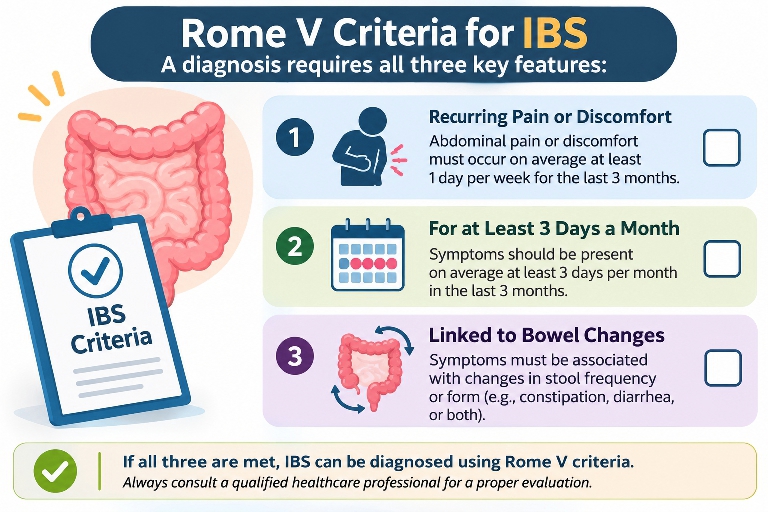
For IBS, Rome V asks for recurring abdominal pain or discomfort that is not continuous, present on average at least 3 days a month over the last 3 months, and linked to at least two of three things: bowel movements, stool frequency and stool appearance. The symptoms should have started at least 6 months before the diagnosis.
Rome V requirement
What it means in everyday terms
Recurrent pain or discomfort, but not continuous
It comes and goes. Pain that is there all day, every day, is a different diagnosis (centrally mediated abdominal pain syndrome), which Rome V now separates from IBS
On average at least 3 days a month, over the last 3 months
Several uncomfortable days a month. It does not have to happen every week
Linked to two or more of: defecation, stool frequency, stool appearance
The pain eases or worsens with a bowel movement, your frequency changed when it began, your stool looks different, or any two of those
Started at least 6 months ago
The symptoms have been around for half a year, with the pattern holding for the latest 3 months
Not only around your period
Gut pain that shows up only with menstruation does not count toward IBS
What changed from Rome IV
Three things changed. Discomfort is back: Rome IV required pain, and Rome V counts discomfort too, because many people describe an ache or pressure rather than pain. The frequency bar dropped from one day a week to three days a month. And the pain must not be continuous.
The lower bar was deliberate. The Rome Foundation’s global survey found that the weekly rule cut the share of people qualifying for IBS from roughly 10% to 4%, mostly by selecting a more severely affected group than the one seen in clinics. So if someone once told you that you did not quite meet the criteria because your pain came a few times a month, the current rule may fit you better.
rome v ibs criteria checklist
Clinical criteria versus research criteria
The exact numbers matter most in research. For everyday care the Foundation recommends its clinical criteria instead. The symptom pattern still has to match, and the symptoms must be bothersome enough to send you to a doctor or to get in the way of daily life, but the frequency can fall below the research threshold. The six-month rule relaxes too. The Foundation suggests about eight weeks of symptoms, long enough to exclude other causes, and a shorter wait is fine once the clinician is satisfied that testing has ruled out other disorders.
That matters because a large group falls between the lines. In a worldwide survey of more than 50,000 adults, about one in four had gut symptoms without meeting any Rome diagnosis, and they reported lower quality of life, more anxiety and more health care use than people without symptoms. The clinical criteria exist so those people can still be diagnosed and treated.
How doctors diagnose IBS, step by step
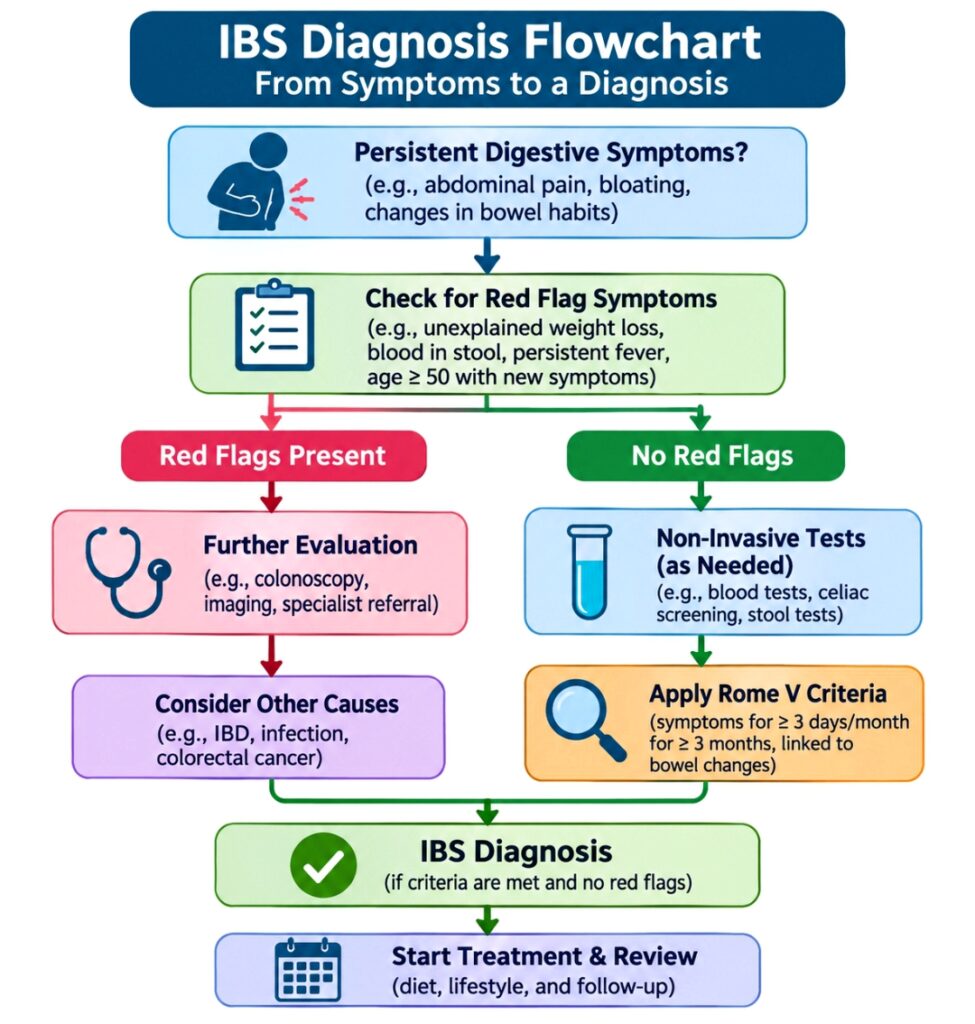
The ACG recommends what it calls a positive diagnostic strategy. The idea is to use your history, an exam and a few targeted tests to make the diagnosis, instead of testing for everything and settling on IBS only when nothing else turns up. The ACG says this gets people to treatment sooner and costs less.
You would think that was settled, and it is not. A paper in the British Journal of General Practice reported that about 70% of the GPs surveyed still believed IBS was a diagnosis of exclusion, which is one reason people end up with scans and scopes they did not need.
A visit usually runs in this order.
The history. This is the main event, and it is mostly talk. Expect questions about where the pain is, when it comes, whether a bowel movement changes it, what your stools look like, how often you go, whether anything wakes you at night, what you eat, which medicines you take, whether it began after a stomach bug, and who in your family has bowel disease.
A red flag check. The doctor listens for the warning signs in the next section, because a single one can change the whole plan.
A physical exam. The doctor feels and listens to your abdomen. A rectal exam is sometimes added, and it is brief and useful when constipation or bleeding is part of the story.
A short round of tests. Usually blood work and, when diarrhea dominates, a stool marker for inflammation. The section after the red flags covers which tests and why.
Matching the pattern. The doctor compares your story with the Rome criteria, names the subtype and explains what you have in plain language. A good diagnostic visit ends with a name, not a shrug.
A treatment trial, then a recheck. If a sensible first approach does not help, if your symptoms change, or if warning signs appear, the doctor widens the work-up. The ACG notes that colonoscopy may be appropriate at that point.
Many people are diagnosed by a family doctor or general practitioner. A gastroenterologist usually joins in when there are red flags, when the story does not fit cleanly, or when first-line treatment fails. In a classic case with no red flags the diagnosis can happen at the first visit, with the tests following. Waiting on results usually adds a second visit.
ibs diagnosis flowchart
Red flag symptoms that change the plan
Red flags, also called alarm features, are findings that IBS does not explain. They do not mean cancer, and most people who have one turn out to have something treatable or harmless. What they do is move you from a positive diagnosis to a closer look, which often includes a colonoscopy. The lists from the ACG and NICE overlap heavily, so the table below combines them.
Red flag
Why it matters
What usually happens next
Blood in the stool or bleeding from the rectum
IBS does not cause bleeding. Hemorrhoids and fissures are the usual culprits, but polyps, IBD and cancer produce it too
Exam, blood tests and usually a colonoscopy, depending on age
Weight loss you did not intend
IBS should not make you lose weight without trying
Blood tests, scopes or imaging as the picture suggests
Anemia or low iron on a blood test
Points to blood loss or poor absorption, as in celiac disease
Celiac testing and often scopes of the upper and lower gut
Pain or diarrhea that wakes you at night
The ACG counts nighttime bowel movements as an alarm feature, and IBS symptoms usually settle during sleep
Family history of colorectal or ovarian cancer, IBD or celiac disease
Raises the odds that another condition is involved
A lower threshold for tests and scopes
New symptoms in middle age or later (NICE flags looser, more frequent stools lasting over six weeks in anyone over 60)
IBS usually begins earlier in life, so a fresh change later needs checking
Colonoscopy or a cancer-pathway referral
Symptoms that are severe or steadily getting worse
IBS tends to come and go, so steady progression is unusual
A wider work-up
Two points of nuance. Pain that stays in one fixed spot is worth mentioning, because NICE notes that IBS pain can be felt anywhere in the abdomen and tends to move around, while cancer-related pain typically stays put. And having IBS does not protect you from the diseases above. The evidence behind the NICE guideline, summarized in the BMJ, found that people with IBS were no more likely than anyone else to have colon cancer, IBD, thyroid disease or lactose malabsorption, but no less likely either. A new red flag in someone with a long-standing IBS label deserves the same attention it would get in anyone else.
Tests doctors may order, and what each one is for
The point of testing in suspected IBS is not to find IBS. It is to catch the small number of conditions that look like it. That is why the list is short, and why two people with the same symptoms can leave with different tests.
Test
Who usually gets it
What it looks for
Complete blood count
Most people with symptoms, and everyone on the NICE pathway
Anemia, which can point to bleeding or celiac disease, and signs of infection
CRP (and ESR in the UK)
Most people on the NICE pathway. The ACG adds CRP for IBS with diarrhea
General inflammation in the body, with IBD as the main concern
Celiac blood test (tissue transglutaminase antibodies, usually with a total IgA level)
The ACG recommends it for IBS with diarrhea. NICE lists it for everyone with IBS symptoms
Celiac disease, which causes pain, bloating and bowel changes and is easy to miss. You need to be eating gluten at the time, or the result can come back falsely normal
Fecal calprotectin (or lactoferrin)
IBS with diarrhea and no alarm features
Inflammation in the bowel wall. A normal result makes IBD unlikely and spares many people a colonoscopy
Stool tests for infection
Only with a clear reason, such as recent travel or a high risk of Giardia
Giardia and other infections. The ACG advises against doing them routinely
Colonoscopy
Red flags, symptoms that do not respond to treatment, or screening age (45 and over in the US)
Colon cancer, IBD and, with biopsies, microscopic colitis
Doctors sometimes add a thyroid test, liver tests or a pregnancy test depending on the story. The ACG’s full IBS guideline dates from 2021, so it was written before Rome V, and the Rome Foundation publishes its own diagnostic algorithms for clinicians separately.
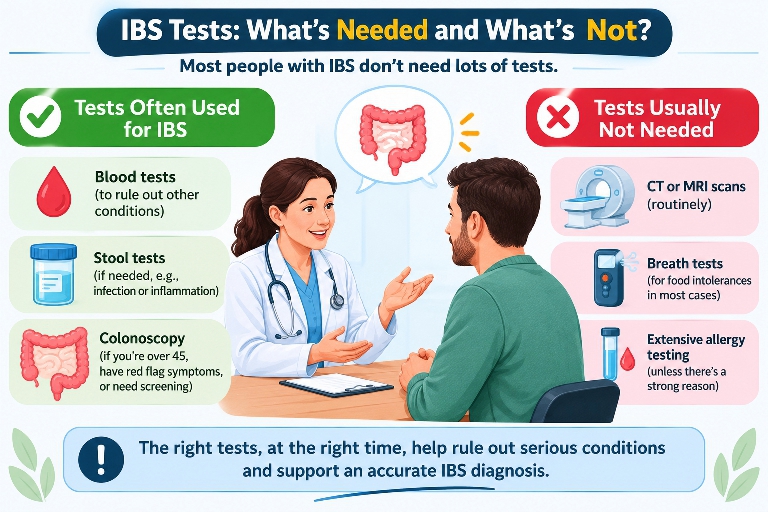
ibs tests needed vs not needed
Tests you usually do not need
A long list of tests gets offered for IBS, in clinics and online, and most of them do not help with the diagnosis.
Test or offer
Why it is usually unnecessary
Colonoscopy for everyone
The ACG advises against routine colonoscopy under 45 without alarm features, apart from cancer screening. NICE says scopes are not needed to confirm IBS in people who meet the criteria
Abdominal ultrasound, barium studies or flexible sigmoidoscopy
NICE lists them as unnecessary for confirming IBS
Breath tests for bacterial overgrowth or lactose intolerance, and pancreatic function tests
NICE lists hydrogen breath testing as unnecessary for confirming IBS, and the British Society of Gastroenterology found no role for either type of test in people with typical IBS symptoms
Food allergy or IgG food sensitivity panels
The ACG advises against testing everyone with IBS for food allergies or sensitivities unless reactions repeat in a way that suggests a true allergy. The BSG recommends against diets built on IgG results
Stool microbiome or gut health kits
Rome describes differences in gut bacteria in IBS, but no microbiome test is part of any guideline for diagnosing it
What about IBS blood tests?
Two blood tests sold for IBS, IBSchek and IBS-Smart, measure antibodies (anti-CdtB and anti-vinculin) that turn up in some people whose IBS began after a gut infection. In the main validation study the test was very specific, about 92% when separating IBS-D from IBD, but it missed more than half of cases, with a sensitivity around 44%. A positive result supports the diagnosis. A negative result does not rule IBS out. The tests are aimed at IBS-D and IBS-M, not IBS-C.
A 2020 review in American Family Physician found no evidence yet that using the test improves care. William Chey, one of the authors of the ACG guideline, said in a 2019 interview that the early data were promising but not robust enough to support a recommendation. If you are tempted to order one yourself, talk to your doctor first.
Conditions that can look like IBS
Because IBS has no test of its own, much of the diagnostic work is about not missing its look-alikes. Some are common, some are serious, and several are simple to treat once someone finds them.
Condition
A clue that points away from IBS
How it is checked
Celiac disease
Anemia, weight loss, a family history, or symptoms that follow wheat, barley and rye
Celiac antibody blood test, confirmed with biopsies
Blood or mucus in the stool, night symptoms, fever, weight loss, a high CRP or calprotectin
CRP, fecal calprotectin, colonoscopy
Microscopic colitis
Long-lasting watery diarrhea, often in older adults, with a normal-looking colon
Colonoscopy with biopsies
Colorectal cancer
A new change after 45 to 50, bleeding, anemia, weight loss, pain that stays in one spot
Colonoscopy
Bile acid diarrhea
Chronic watery diarrhea with urgency soon after meals, sometimes after gallbladder removal
Bile acid tests where available, or a trial of treatment
Lactose intolerance and other sugar malabsorption
Gas and loose stools within hours of dairy or particular sugars
A short elimination trial, sometimes a breath test
Medicines and supplements
Symptoms began or changed after starting a product. Metformin, magnesium, iron, opioids and the sorbitol in sugar-free gum are common examples
A medication review
Pelvic floor dysfunction (dyssynergic defecation)
Straining, a feeling of blockage, needing to press or use a finger to empty the bowel
Anorectal tests such as manometry and a balloon expulsion test
Endometriosis and other pelvic conditions
Pain that follows your cycle, pain with sex, bowel symptoms that flare around periods
Gynecological assessment, often with imaging
Thyroid disease
Weight change, palpitations, feeling too hot or too cold, tiredness
Thyroid blood test
Infection such as Giardia
Watery diarrhea after travel or exposure to untreated water
Stool test
Small intestinal bacterial overgrowth (SIBO) deserves a line of its own, because it is a popular explanation for bloating and diarrhea and breath tests for it are easy to find. The British Society of Gastroenterology found no role for breath testing in people with typical IBS symptoms, so a positive result on its own should not replace the diagnosis your doctor has reached.
Symptoms that began after a stomach bug are worth mentioning. Postinfection IBS is well recognized, and the Rome Foundation has a working team devoted to it. It still counts as IBS once an infection such as Giardia has been excluded.
How to prepare for your appointment
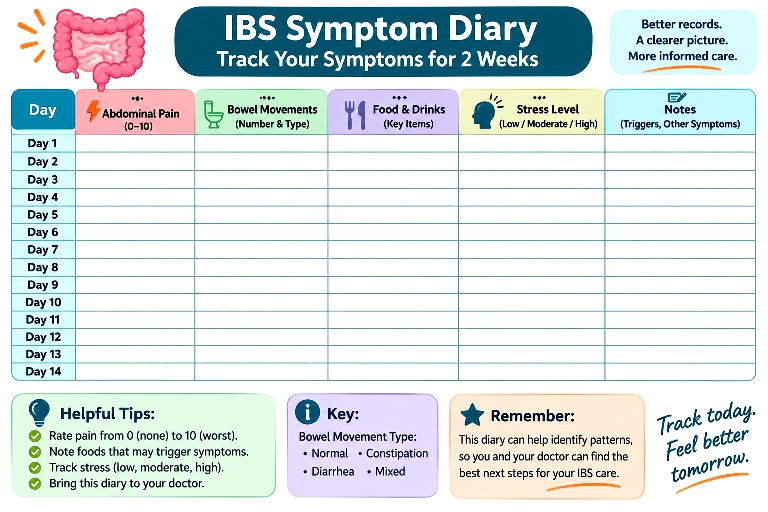
A symptom diary is the most useful thing you can bring. The ACG’s patient summary suggests daily entries for two weeks to get the most accurate picture, and the Rome Foundation suggests one to three weeks. A diary turns my stomach is bad a lot into a pattern a doctor can read in a minute.
Here is a layout you can copy into a notebook or a phone note. The first row is invented, to show the level of detail that helps.
Date
Pain or discomfort
Bowel movements
Other symptoms
Food, drink and medicines
Sleep, stress, period
Example: Monday
4 out of 10, lower left, after lunch, eased after a bowel movement
3 times, Bristol types 6, 6 and 7
Bloated by evening, urgent in the morning
Oats, two coffees, leftover curry, ibuprofen at noon
Slept 5 hours, work deadline, day 2 of period
Tuesday
Wednesday
ibs symptom diary template
A few other things are worth bringing.
When it started, and whether it followed a stomach bug, a course of antibiotics or a stressful stretch
A full list of medicines and supplements, including over-the-counter pain relievers, antacids, laxatives, magnesium and probiotics
Any family history of colon cancer, IBD, celiac disease or ovarian cancer
Results of tests you have already had, and treatments you have already tried
The symptoms you would rather not mention. Doctors hear about stool, gas and urgency all day, while blood, night symptoms and weight loss change the plan
And a few questions are worth asking.
Do my symptoms meet the Rome criteria, and which subtype do I seem to have?
Which red flags did you check for, and did I have any?
Which tests do I need and why, and which can I skip?
If the tests are normal, is IBS the working diagnosis, and what happens next?
What changes should send me back sooner?
Who should I see next, if anyone?
Myths about diagnosing IBS
A few ideas keep circulating in forums and, now and then, in clinics. They lead to either needless testing or needless worry.
Myth
What is closer to the truth
Every other disease has to be ruled out first
The ACG and the Rome Foundation both favor a positive diagnosis built on your symptoms, an exam and a few targeted tests
Nobody can diagnose IBS without a colonoscopy
Most people under 45 with no red flags do not need one, according to the ACG, and NICE says a scope is not needed to confirm IBS in someone who meets the criteria. Red flags and screening age change that
Normal test results mean it is all in your head
Normal scans show the bowel is not damaged, which is part of the definition. IBS involves a gut that is oversensitive or moves abnormally, and the Rome Foundation points to altered motility, visceral hypersensitivity, gut immune changes and altered gut-brain signaling
Stress causes IBS
Stress can make symptoms worse, and a long-term illness is itself stressful, but IBS is not a purely psychological condition
A food sensitivity panel or a microbiome kit will settle it
No guideline supports either for diagnosis, and both the ACG and the BSG advise against IgG-based panels and diets
IBS eventually turns into IBD or cancer
IBS does not raise your risk of either. It does not protect you from them, so new red flags always need attention
Missing the exact Rome numbers means you do not have a real problem
The numbers are mainly for research. The clinical criteria let doctors diagnose and treat people whose symptoms are bothersome but fall a little short
After the diagnosis: what happens next
A diagnosis is a starting point. The Rome Foundation estimates that about 40% of people with IBS have mild symptoms, about 35% moderate and about 25% severe, and the plan scales with that. NICE describes IBS as chronic and relapsing, which means flare-ups and quiet spells rather than a steady slope.
The usual building blocks, in the order most doctors reach for them:
Education. Knowing that IBS is real, common and not dangerous has treatment value of its own, and the Rome Foundation says so.
Diet. Regular meals, soluble fiber and, for some people, a limited trial of a low FODMAP diet. The ACG recommends the trial, and a dietitian makes it safer and shorter.
Medicines matched to the subtype. Examples are prescription drugs that loosen the bowel in IBS-C, rifaximin in IBS-D, and low-dose tricyclic antidepressants for pain and overall symptoms. The ACG’s guideline lays out the choices.
Gut-directed psychological therapy, such as cognitive behavioral therapy or gut-directed hypnotherapy. The ACG suggests it, and the Rome Foundation recommends it for moderate to severe symptoms. It treats the gut-brain loop, not an imagined problem.
Go back to your doctor if a fair trial of treatment does not help, if the character of your symptoms changes, or if any red flag from the earlier table shows up. The diagnosis is a working conclusion, and a good doctor expects to revisit it.
When to see a doctor, and when it is urgent
Book an appointment if any of these apply:
Pain, bloating or bowel changes keep coming back for more than a few weeks, or they are bad enough to affect work, sleep or plans
You have any red flag from the table above, even a mild one
Black, tarry stools, or heavy red blood in the stool
Dizziness on standing, very dark urine or very little urine, which can mean dehydration
A swollen, painful belly with no gas or stool passing, which can mean a blockage
Fainting or a racing heart with any of the above
None of those is typical of IBS. If you are unsure which list your symptoms belong on, phone a doctor or a nurse line and ask. It is a fair question, and it is better answered early.
FAQs
How is irritable bowel syndrome diagnosed?
Doctors diagnose IBS from a symptom pattern that fits the Rome criteria, after a history, an exam, a check for red flags and a few targeted tests. No single test confirms it.
Can IBS be diagnosed without tests?
Rarely. A classic story with no red flags can be enough to start treatment, but most people get at least a few blood and stool tests to rule out celiac disease and inflammation first.
What tests are used to diagnose IBS?
None of them diagnose IBS itself. Doctors use blood tests (blood count, CRP, celiac antibodies), a stool marker called fecal calprotectin when diarrhea dominates, and colonoscopy only when red flags or screening age apply.
Is there a blood test for IBS?
Two are sold, IBSchek and IBS-Smart, but they look for antibodies seen mainly in IBS that followed an infection, they miss more than half of cases, and guidelines do not recommend them as a way to diagnose IBS.
Do I need a colonoscopy to be diagnosed with IBS?
Usually not if you are under 45 and have no red flags, according to the ACG. You may need one if you have red flags, if you are of screening age, or if treatment fails.
What are the Rome V criteria for IBS?
Recurrent, not continuous, abdominal pain or discomfort on average at least 3 days a month over the last 3 months, linked to at least two of three things: bowel movements, a change in stool frequency and a change in stool appearance. Symptoms should have started at least 6 months before diagnosis.
What is the difference between Rome IV and Rome V?
Rome V, published in 2026, counts discomfort as well as pain, lowers the frequency threshold from one day a week to three days a month, and requires that the pain is not continuous.
How long do symptoms have to last before IBS can be diagnosed?
The research criteria ask for symptom onset at least 6 months before diagnosis. The clinical criteria suggest about 8 weeks, long enough to exclude other causes, and a shorter wait is fine once the clinician is satisfied that testing has ruled out other disorders.
Can I diagnose IBS at home?
You can keep a diary and recognize a pattern, but a diagnosis needs someone to check for red flags and rule out look-alike conditions. At-home test kits cannot do that.
What is the difference between IBS and IBD?
IBD (Crohn’s disease and ulcerative colitis) causes visible inflammation and damage, with signs such as blood in the stool, weight loss, fever and a high calprotectin. In IBS the bowel looks normal. The two need different treatment.
Can you have IBS and another condition at the same time?
Yes. People often have more than one gut-brain disorder at once, such as IBS with functional dyspepsia, and IBS can sit alongside other conditions, which is one reason a doctor reviews the diagnosis if treatment does not help.
Which doctor diagnoses IBS?
Family doctors and general practitioners diagnose it often. A gastroenterologist usually becomes involved when there are red flags, when the picture is unclear, or when first-line treatment does not work.
Can children be diagnosed with IBS?
Yes, with different criteria. Rome V asks for abdominal pain on average at least 4 days a month for at least 2 months, linked to bowel changes, with pain as the main symptom, after a doctor has judged that no other condition explains it.
The short version
IBS is diagnosed from your symptoms. No scan, scope or blood draw confirms it.
Under the 2026 Rome V criteria, doctors look for recurring, non-continuous abdominal pain or discomfort, on average at least 3 days a month, linked to bowel movements or to changes in stool frequency or appearance.
Red flags such as bleeding, weight loss, anemia, night symptoms, fever, a family history of bowel cancer or new symptoms in middle age change the plan and usually mean more testing.
A small panel of tests (blood count, an inflammation marker, celiac antibodies and, for diarrhea, fecal calprotectin) screens for look-alikes. Colonoscopy is for red flags and screening age.
A two-week symptom diary and a list of your medicines make the visit shorter and the diagnosis faster.
Sources
Sources last checked on November 15, 2026. Guidelines are updated from time to time, so recheck the Rome, ACG and NICE pages before you republish.
Hi, I’m the owner and writer of Your Health Style. I write about health and daily habits based on research and real-life experience. My goal is to share information and ideas that are practical, evidence-based, and helpful for building healthier routines that last.
Asian Americans for Community Involvement, along with local AAPI organizations nationwide, are creating healthier communities through specialized health and…