NAION symptoms: early signs, causes, the GLP-1 link and what to do next
NAION symptoms are easy to brush off for one reason: nothing hurts. Someone wakes up, rubs one eye, and notices the other one is dim, smudged or missing a piece of the picture. There is usually no pain and no redness, so nothing tells them to hurry, and the day gets postponed.
NAION stands for non-arteritic anterior ischemic optic neuropathy. The long name hides a simple idea: the front of the optic nerve briefly gets too little blood, swells, and some of its fibers die. Doctors often call it an eye stroke, which is a fair shorthand, even though it is a different event from a blocked artery inside the retina.
Quick answer: the main NAION symptom is sudden, painless vision loss in one eye, usually as blur, dimness or a dark patch, often noticed on waking and sometimes with faded colors. If that happens to you, get examined the same day.
Update, November 10, 2026: on November 9 the US FDA ordered a NAION warning onto the label of every GLP-1 medicine, including Ozempic, Wegovy, Mounjaro and Zepbound. What that does and does not mean is covered in the GLP-1 sections below.
What NAION is, in plain words
The optic nerve is the cable that carries what your eye sees to your brain. Where that cable leaves the eyeball, its visible end is called the optic disc, and a handful of tiny arteries feed it. NAION happens when their blood flow dips for long enough that the disc swells and the nerve fibers inside are injured.
The swelling is the cruel part. The disc sits in a very tight space, so a swollen nerve fiber has nowhere to go, and it squeezes the same small vessels that were already short of blood. Researchers describe it as a vicious circle, and by the time it ends, some nerve cells are gone for good.
Two details explain a lot about who gets it.
Many people with NAION were born with a small, crowded optic disc that has little or no empty space (the cup) in the middle. Eye doctors call this a disc at risk, and one major reference says up to 97% of people with NAION have one. The other eye usually has the same shape, which is why doctors always look at it.
NAION is the most common sudden optic nerve problem in adults over 50, and the average age at onset is about 66. Younger adults get it too. One referral center found that 23% of its anterior ischemic optic neuropathy patients were under 50.
The words non-arteritic matter. The arteritic form is caused by inflamed blood vessels, mainly giant cell arteritis, and it is a different emergency with a different treatment. Ruling that out is the first job of any doctor who sees a swollen optic disc.
NAION symptoms: what it looks and feels like
The textbook picture is sudden vision loss in one eye with no pain. Many people notice it first thing in the morning. In one often-quoted series, about three in four found the loss when they woke up, which fits the idea that blood pressure dips overnight. The rest spot it during the day, usually when they happen to cover one eye and realize the other is not seeing properly.
What you may notice
What it can feel like
Blurred or dim vision
Looking through a smudged lens or a thin fog with one eye
A missing area
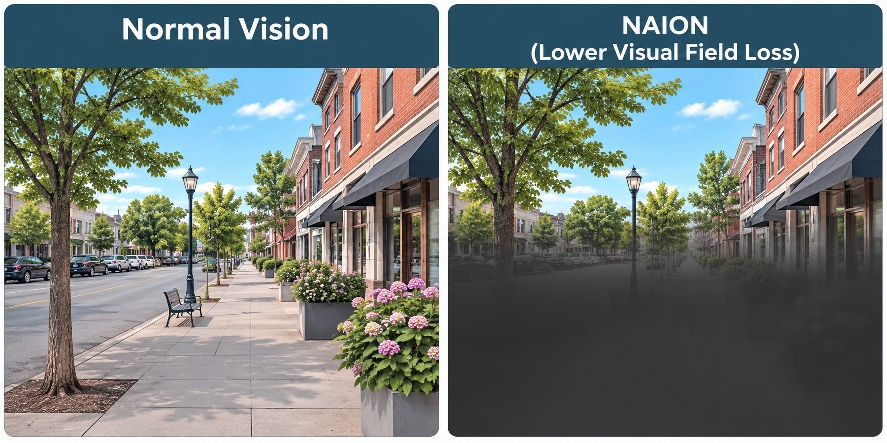
A shadow or curtain over the lower half is the classic pattern. Blind patches near the center or arc-shaped gaps also happen
Faded colors
Reds and other colors look washed out compared with the other eye
Lower sharpness
Reading, faces and street signs are harder with that eye
Little or no pain
Pain is not typical, and when it is present it is a reason to look for another cause
How severe it is varies a great deal. In clinical series, about half of people have vision better than 20/64 when they first present, and roughly two thirds are better than 20/200. Some keep nearly normal sharpness and mainly notice the missing area. Complete darkness with no light perception is rare, and when it does happen doctors start suspecting the arteritic form instead.
naion-visual-field-loss-compariso
Early symptoms of NAION
Early symptoms look like the full picture, only fainter, and that is the trap. A patch of vision that seems slightly gray. Trouble reading the bottom of a menu with one eye. A sense that one eye is running at lower brightness than the other. People often describe it as a smudge they cannot wipe away.
A ten-second check helps, although it is not a medical test. Sit in good light, cover your left eye and look at something familiar, such as a doorframe or a phone screen. Then cover your right eye and compare. If one eye has changed, do not wait to see whether it passes. NAION has no gentle warm-up stage, and what you see in the first hours is usually most of what you will see, though a minority of people get worse over the following weeks.
Mild NAION
Mild cases exist. Some people lose only a small part of the visual field or have a modest blur, and a few keep near-normal sharpness. Mild does not mean harmless. The same blood flow problem sits behind it, the other eye usually has the same crowded disc, and a small deficit still needs a proper exam. It mostly tells you the damage was limited, not that nothing happened.
Does NAION cause pain or headaches?
Usually not. A review in the American Academy of Ophthalmology’s EyeNet magazine says eye discomfort or headache turned up in about 10% of patients, so it is not unheard of, but pain is a reason to widen the search. Pain when you move the eye points toward optic neuritis. Jaw pain when chewing, scalp tenderness, fever or a new headache in someone over 50 points toward giant cell arteritis, which needs urgent blood tests.
Other causes of sudden vision loss that can look like NAION
Not every sudden dim eye is NAION, and the look-alikes are the reason a same-day exam is worth the trouble. Some of them threaten your sight or your health in ways NAION does not.
Condition
Pain?
How it starts
What stands out
NAION
Rarely
Suddenly, often on waking
Painless, swollen optic disc, and a crowded disc in the other eye
Arteritic AION (giant cell arteritis)
Often a headache, jaw pain or scalp tenderness
Suddenly, sometimes after brief spells of vision loss
Usually worse vision, plus fever, fatigue or muscle aches. Blood inflammation markers are raised, and it needs high-dose steroids at once
Optic neuritis
Yes, often worse when the eye moves
Over hours to days
More common in younger adults. Colors look much worse than the sharpness loss would predict
Retinal artery occlusion
No
Suddenly
A true stroke of the retina, handled as a stroke emergency
Retinal detachment
No
Often with new floaters or flashes
A curtain creeping in from the edge of vision
Giant cell arteritis is the one doctors worry about most. It mostly affects people over 50 and becomes far more common after 70. If it is missed, the second eye can lose vision within a week or two, so eye doctors order blood tests (ESR, CRP and a platelet count) for almost anyone over 50 with this kind of vision loss. When suspicion is high they start steroids without waiting for a biopsy to come back.
A few rarer things can also mimic NAION, including a tumor pressing on the nerve and an antibody-driven inflammation called MOG antibody disease. That is why an MRI is sometimes ordered when the story or the exam does not fit the classic pattern.
When to get help, and what to tell the doctor
Treat sudden vision loss in one eye as an emergency, even when it is painless and even when it seems to be improving. Go to an eye emergency service or a hospital emergency department the same day. Booking a routine appointment for next week is the wrong move here.
Go straight away if:
Vision in one eye suddenly turns blurry, dim or patchy
A shadow or curtain covers part of what you see
Colors look faded in one eye only
Any of that comes with jaw pain, scalp tenderness, fever or a new headache
You take a GLP-1 medicine and any of this appears
Until you are seen, do not drive. Do not stop prescription medicines on your own because of something you read online, and that includes GLP-1 drugs. Bring it up with the clinician who examines you.
naion-same-day-care-checklist
The doctor will ask a lot of questions, and your answers shorten the visit. It helps to have these ready:
Which eye, and exactly when you noticed (on waking or during the day)
Whether anything hurts, including headaches, jaw pain and pain when the eye moves
A full medicine list: blood pressure pills and the time of day you take them, Ozempic, Wegovy, Mounjaro, Zepbound or similar drugs, erectile dysfunction medicines such as sildenafil or tadalafil, and amiodarone
Whether you snore loudly, stop breathing at night or wake up unrefreshed
Your history of diabetes, high blood pressure, high cholesterol and smoking
What causes NAION?
Nobody has a complete answer. The leading explanation has two parts: an optic nerve head built with very little spare room, and a moment when blood flow to it falls short. The crowded disc is the anatomy. The blood supply is the trigger, since the nerve head is fed by short posterior ciliary arteries and normally adjusts its own flow. Anything that weakens that adjustment, or lowers the pressure pushing blood in, makes a bad moment more likely.
The risk factors that come up again and again:
High blood pressure, diabetes, high cholesterol and smoking, the same list that drives heart attacks and strokes
Obstructive sleep apnea. One analysis put the relative risk of sleep apnea in NAION patients at 4.9 compared with the general population, and in one often-cited series almost nine in ten newly diagnosed patients who had a sleep study turned out to have moderate or worse apnea
Overnight drops in blood pressure. So many people notice symptoms on waking that researchers suspect a low point during the night, which blood pressure pills taken at bedtime can deepen. Some specialists advise against bedtime dosing after NAION. Never change the timing yourself, but it is a fair question for your doctor
Certain medicines named in reports, including erectile dysfunction drugs (PDE-5 inhibitors), amiodarone and interferon alpha. The PDE-5 evidence is mixed, and one meta-analysis found no significant link
Anemia and kidney disease, both named in the FDA’s November 2026 notice
Optic disc drusen, small deposits in the nerve head that crowd the disc and are a common finding in younger patients
Less often, clotting disorders in people under 50 who have no vascular risk factors, and a handful of reports tied to eye surgery such as cataract surgery
Sometimes there is no clear cause at all. That is an unsatisfying answer, and it is the honest one.
NAION and GLP-1 drugs: Ozempic, Wegovy, Mounjaro and Zepbound
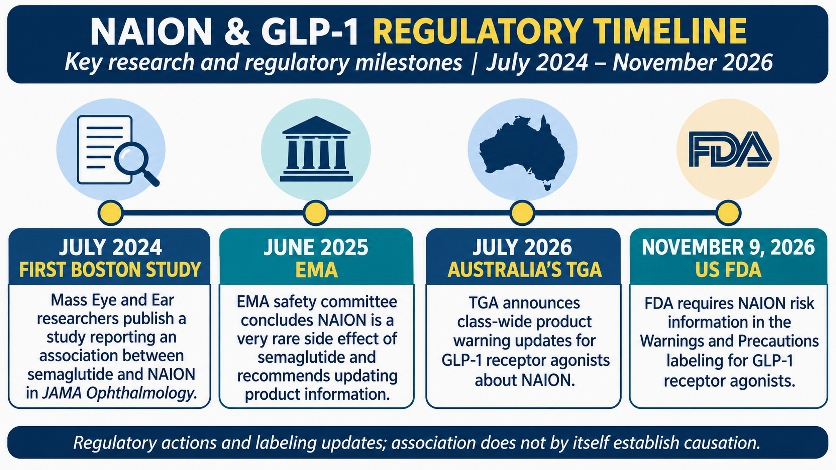
This is the part of the NAION story that has moved fastest. On November 9, 2026, the US Food and Drug Administration issued a Drug Safety Communication requiring every GLP-1 receptor agonist label to carry a warning about a potential increased risk of NAION. The warning goes into the Warnings and Precautions section, and it covers the whole class rather than only semaglutide. That includes Ozempic, Wegovy and Rybelsus (semaglutide), Mounjaro and Zepbound (tirzepatide), Victoza and Saxenda (liraglutide), Trulicity (dulaglutide), exenatide, and the newer oral drug orforglipron (Foundayo).
The FDA described a potential increased risk of a rare event, and said NAION cases have been reported with every marketed product in the class. It also said its animal data did not explain how these drugs might affect the optic nerve. Its advice to clinicians is to tell patients to report sudden, painless vision loss, gaps in the visual field or other visual changes in one eye right away, to refer suspected cases to an ophthalmologist promptly, and to consider stopping the GLP-1 drug in anyone who develops NAION unless the benefits clearly outweigh the risk. Patients who have had NAION are told to ask their clinician whether to continue or stop.
Other regulators got there earlier, and mostly with a narrower focus on semaglutide:
Regulator
When
What it decided
European Medicines Agency (PRAC)
June 2025
NAION is a very rare side effect of semaglutide (Ozempic, Wegovy, Rybelsus), meaning up to 1 in 10,000 users. Patients with sudden vision loss should contact a doctor without delay, and semaglutide should be stopped if NAION is confirmed
UK MHRA
February 2026
Drug Safety Update saying semaglutide may very rarely be associated with NAION
Australia TGA
July 2026
Class-wide product information update covering all GLP-1 RA medicines sold there
US FDA
November 9, 2026
Class-wide Warnings and Precautions update for every GLP-1 RA, tirzepatide included
naion-glp1-regulatory-timeline
What about Mounjaro, Zepbound and tirzepatide?
Here the evidence is thinner, and an honest article has to say so. Earlier in 2026, the North American Neuro-Ophthalmology Society and the American Academy of Ophthalmology judged the evidence for tirzepatide and the other GLP-1 drugs insufficient, while cautioning doctors not to assume the concern stops at semaglutide. A Canadian analysis of FDA adverse event reports found a signal for semaglutide but none for tirzepatide, although tirzepatide has been on the market for far less time. Australia’s adverse event database listed 10 cases of ischemic optic neuropathy with tirzepatide, against 23 with semaglutide.
The FDA then pooled 126 trials across the whole class and decided the class label should carry the warning. So the regulatory position is now the same for all of these drugs, while the strength of the evidence behind it is not.
How big is the GLP-1 risk, really?
Small in absolute terms, and still being argued over. Both halves matter, so the numbers come first.
Source
What it found
FDA pooled analysis of 126 trials (November 2026)
15 probable NAION events among 134,253 patients. The rate was 6.4 per 100,000 person-years on GLP-1 drugs and 3.8 on placebo or other diabetes drugs
FDA Sentinel cohort, type 2 diabetes, 2019 to 2024
About 26 to 32 cases per 100,000 person-years in every group. No significant difference against SGLT-2 inhibitors (hazard ratio 1.19), a higher risk against DPP-4 inhibitors (1.43)
European Medicines Agency review (June 2025)
Large studies in adults with type 2 diabetes suggested roughly double the risk on semaglutide, about one extra case per 10,000 person-years
JAMA Network Open (August 2025), 159,398 people with type 2 diabetes
NAION in 0.04% on semaglutide or tirzepatide versus 0.02% on other drugs over two years (hazard ratio 1.76)
Annals of Internal Medicine (July 2026), US data
Ischemic optic neuropathy over 18 months: 8.5 per 10,000 on GLP-1 drugs versus 5.5 on SGLT-2 inhibitors
Annals of Internal Medicine (July 2026), Sweden
Anterior ischemic optic neuropathy at one year: 0.04% versus 0.02%. The gap shrank when the comparison was limited to people already taking metformin
Analysis published in April 2026
No higher NAION risk in people with overweight or obesity, and possibly a lower risk with semaglutide than with non-GLP-1 drugs in diabetes
Read together, the studies lean the same way. FDA’s own trial data work out to about 2.6 extra cases for every 100,000 people treated for a year, and that was enough for three regulators to act. Relative-risk headlines sound frightening (a Boston study in 2024 reported hazard ratios of 4.28 in type 2 diabetes and 7.64 in overweight or obesity), but in absolute terms an optometrist commenting on the two 2026 Annals studies put it at roughly one extra case for every 2,500 to 3,300 patients treated over 1.5 to 3 years.
Whether the drugs cause it is not settled. People who take GLP-1 medicines are more likely to have diabetes, high blood pressure and sleep apnea, which are NAION risk factors by themselves, and observational studies cannot fully pull those apart. The authors of one 2026 study even raised the possibility that the signal reflects leftover confounding rather than a true drug effect. A Swedish team listed rapid improvement in blood sugar as an open question. The FDA’s animal data turned up no mechanism.
In the US data, the added risk was concentrated in men, people over 50 and people who already had eye or cardiovascular disease. Among the 81 cases in GLP-1 users, about 85% were 50 or older and about 70% were men.
Our read: the signal looks real enough to take seriously and small enough that most people on these drugs will never meet it. Reasonable doctors land on both sides of the causation question, and the honest summary is that nobody can yet say which side is right.
If you take a GLP-1 medicine
Panic is the wrong response, and so is a shrug. A few concrete steps make sense for almost everyone on one of these drugs.
Learn the warning signs by heart: sudden, painless blur, dimness, a missing patch or washed-out color in one eye, often noticed on waking.
If that happens, get seen the same day by an eye care professional and tell them which medicine you take and when you started. Do not wait for your next prescription review.
Do not stop the medicine on your own because of this article. The neuro-ophthalmology societies warned against reflexive discontinuation, because stopping can carry real metabolic and cardiovascular costs. If NAION is confirmed, the FDA says to consider stopping unless the benefits clearly outweigh the risk, and European guidance says to stop semaglutide. That decision belongs to you, your eye specialist and the prescriber together.
If you have already had NAION in one eye, or unexplained vision loss in one eye, tell the prescriber before you start or continue. The societies say these patients should hear about the possible risk first.
Ask whether sleep apnea has ever been checked, especially if you snore, are over 50 or have high blood pressure. It is treatable, and it overlaps heavily with the people who get prescribed these drugs.
Keep your routine eye exams and mention the medicine at each one. Commentary on the 2026 studies saw no case for extra screening beyond standard diabetic eye care.
None of this means the drugs are unsafe for most people. Obesity and diabetes carry their own well-documented risks to the heart, kidneys and eyes, and for many patients the trade is clearly worth making. The aim is to be informed, not frightened.
How common is NAION?
Rare, but not exotic. The estimated yearly incidence in the United States is 2.3 to 10.2 cases per 100,000 adults over 50, and about 0.54 per 100,000 when all ages are counted. Older estimates put it at roughly 6,000 new cases a year. Men and women are affected about equally, the average age at onset is about 66, and in US data it is reported more often in White people than in other groups.
It is the most common cause of sudden optic nerve damage in adults over 50 and, after glaucoma, the second most common optic neuropathy overall.
For perspective on the GLP-1 figures above: the FDA’s trial pooling found 3.8 cases per 100,000 person-years in people not taking those drugs, well within the background range. People with type 2 diabetes run higher, which is why the diabetes cohorts show 26 to 32 cases per 100,000 person-years.
How doctors diagnose NAION
No single blood test or scan proves NAION. It is mostly a clinical diagnosis: an experienced eye doctor builds it from your story and what they see inside the eye. In a classic case the exam alone can be enough. The extra tests mostly exist to make sure it is not something that looks identical.
History. When it started, whether it hurt, which medicines you take, whether you snore.
Vision, color and pupil tests. The doctor swings a light between your eyes. A pupil that reacts weakly in the affected eye (a relative afferent pupillary defect) points to optic nerve trouble.
A dilated look at the optic nerve. In NAION the disc is swollen, often with small flame-shaped bleeds. The other eye commonly shows the crowded, cup-less disc that explains why this eye was vulnerable.
A visual field test to map the blind areas. A lower-half loss is the classic result, though central and arc-shaped patterns occur.
Blood tests (ESR, CRP and a platelet count) to look for giant cell arteritis, which in practice means almost everyone over 50.
Further tests when the picture is unusual: OCT scans, MRI of the brain and orbits for pain on eye movement or a slow, progressive course, MOG antibody testing, or a clotting work-up in younger patients with no vascular risk factors.
A sleep study referral if the story suggests sleep apnea, plus blood pressure, blood sugar and cholesterol checks.
Is there a cure? How NAION is treated
No treatment has been proven to restore vision once NAION has happened. That sentence appears in nearly every review written by eye specialists, and it is worth stating plainly because the internet is full of people who would like to sell you an exception.
Plenty has been tried. This is how the main attempts fared.
Approach
What studies found
Oral steroids (prednisone)
Two randomized trials found no difference in final vision. In one, the swelling went down faster, but the end result was the same. Routine use is not recommended, partly because of side effects
Aspirin
No benefit for visual outcome in the acute phase, and a bleeding risk. Low-dose aspirin may still be prescribed for the heart, and it is unclear whether it protects the other eye
Optic nerve sheath surgery
Tested in a major trial that stopped early. The surgery did not help, and patients did worse
Anti-VEGF injections
Early hope, then no benefit in a non-randomized controlled trial
Hyperbaric oxygen, G-CSF, brimonidine
No convincing benefit so far
Erythropoietin
Mixed results and still controversial
QPI-1007 (a gene-silencing injection) and RPh201
Tested in trials without demonstrated benefit
What doctors do instead is what the evidence supports.
Rule out giant cell arteritis, and treat it at once if present
Control blood pressure, diabetes and cholesterol, and stop smoking. The proof that this protects the other eye is thin, but it protects your heart and brain either way
Screen for sleep apnea and use CPAP if it is prescribed. In one study of people with moderate to severe apnea, skipping CPAP went with a four to five times higher chance of NAION in the second eye
Review medicines. Some specialists suggest stopping PDE-5 inhibitors after NAION, after checking with the primary care doctor, because one analysis suggested the second-eye risk may double in people who keep taking them. They also look at the timing of blood pressure medicine and, now, the GLP-1 question
Book follow-up exams, usually about a month after the event and then as advised
Research continues on nerve protection and nerve regeneration, including stem cell and cell transplantation approaches, but all of it is still experimental. Be wary of any clinic or supplement seller that promises to restore vision lost to NAION. No treatment has earned that claim in a trial.
Can NAION be reversed? Is it permanent? Can it get worse?
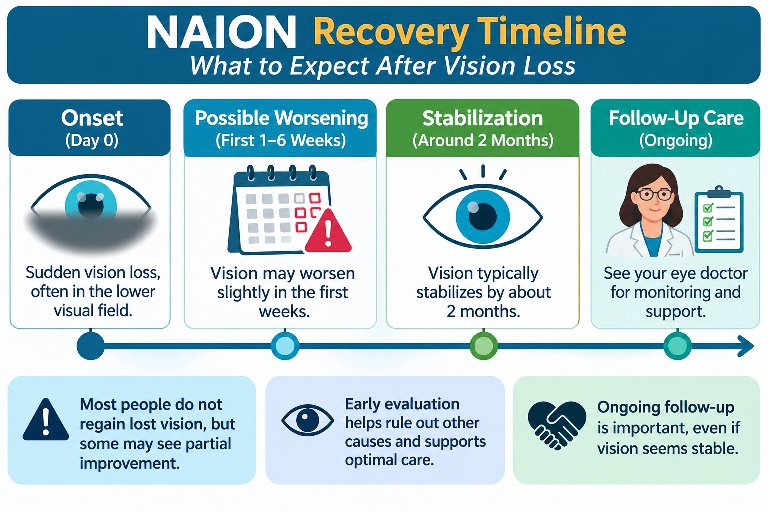
Mostly permanent, sometimes partly better, occasionally worse in the first weeks, and then stable. That is the usual shape.
Question
Honest answer
Can it be reversed?
Complete recovery is unusual. Estimates differ, but a commonly cited split is about 7 in 10 people staying roughly the same, 2 in 10 improving modestly, and 1 in 10 getting worse over the first four weeks. An older trial reported that around 4 in 10 untreated patients gained some lines on the eye chart. A full recovery should make a doctor reconsider the diagnosis
Is it permanent?
The structural damage usually is. The swelling settles, then the nerve turns pale. Vision can improve a little, but the lost nerve fibers do not grow back
Can it get worse?
In the first weeks, yes, in a minority. It normally stabilizes by about two months. Worsening after that is unusual and is a reason to look for another cause
Will it come back in the same eye?
Uncommon, about 5%. The damaged nerve no longer has a crowded disc
What about the other eye?
About 15% within five years, and 15 to 20% in some series. Diabetes, severe sleep apnea, skipping CPAP and optic disc drusen in both eyes go with higher risk. In one Chinese study, people with diabetes had a second-eye attack after a median of 14 months, against 122 months for people without diabetes
Sharpness and the visual field can follow different courses, so the eye chart alone does not tell the whole story. Some people gain a few lines on the chart while the missing patch barely changes.
naion-recovery-timeline-infographic
A rough timeline looks like this:
Day one: sudden, painless loss, often noticed on waking
Weeks one to four: a minority get worse, while the disc swelling gradually fades
Around two months: vision usually settles, and the optic disc looks pale
After that: a stable picture, with regular checks and attention to the other eye
Protecting the other eye
About one person in seven who has NAION in one eye gets it in the other within five years, and some series report 15 to 20 percent. That number frightens people, and it is also the best reason to act now. The second eye usually has the same crowded optic disc, so the anatomy that allowed the first attack is still there. What you can change is how often blood flow to that disc runs short.
What to do
Why it is on the list
A question for your doctor
Keep blood pressure, blood sugar and cholesterol in range
The vessel damage behind heart attacks and strokes also narrows the supply to the optic nerve. In one Chinese study, people with diabetes had their second attack after a median of 14 months, against 122 months for people without diabetes
Are my numbers where they should be for someone who has had NAION?
Test for sleep apnea, and use CPAP if it is prescribed
In a study of people with moderate to severe apnea, skipping CPAP went with a four to five times higher chance of NAION in the second eye
Should I have a sleep study?
Check when you take blood pressure pills
Pressure dips overnight, and many attacks are noticed on waking. Some specialists advise against bedtime doses after NAION
Does the timing of my blood pressure medicine matter in my case?
Review medicines that may matter
Erectile dysfunction drugs (PDE-5 inhibitors) and amiodarone appear in reports. One analysis suggested the second-eye risk may double in people who keep taking a PDE-5 inhibitor. GLP-1 drugs are now part of this conversation too
Which of my medicines should we reconsider, and which should we keep?
Stop smoking
It adds to the same vascular damage that sits behind most NAION cases
What help is available to quit?
Leave aspirin to your doctor
Aspirin did not improve vision in the acute phase and carries a bleeding risk. Nobody can yet say it protects the other eye
Is low-dose aspirin right for my heart?
The good eye also needs watching. After a first attack, the other eye does most of the seeing, and a change in it can go unnoticed for days. Every so often, cover one eye, look at a doorframe or a phone screen, then switch and compare. It is not a medical test, but it takes ten seconds, and it is how many people catch a problem early. A new blur, dim spot or missing patch in the good eye gets same-day care, however slight.
Be realistic about the evidence. No clinical trial has shown that tighter control of these risk factors prevents NAION in the other eye. The American Academy of Ophthalmology explains that managing vascular risk factors is important for reducing cardiovascular and cerebrovascular risks, even though it has not been shown to prevent fellow-eye NAION. These steps remain worthwhile for your overall health, but should be guided by your doctor.
FAQs
What Are the Common Symptoms of NAION?
The most common NAION symptoms include sudden, painless vision loss in one eye, blurred vision, and dark or shadowy areas in the visual field. Some people also experience reduced contrast sensitivity or difficulty seeing clearly. Symptoms are often first noticed upon waking up.
What Are the Early Symptoms of NAION?
Early symptoms of NAION may include blurry vision, a dim or dark area in the upper or lower visual field, and reduced vision in one eye. NAION often develops suddenly, so some people have no noticeable warning signs before vision loss occurs.
Does NAION Cause Eye Pain or Headaches?
NAION typically causes painless vision loss. Eye pain and headaches are not common NAION symptoms. However, sudden vision changes accompanied by a severe headache, scalp tenderness, or jaw pain while chewing may indicate another serious condition requiring immediate medical attention.
Can NAION Cause Sudden Vision Loss or Blindness in One Eye?
Yes. NAION can cause sudden vision loss in one eye, ranging from mild visual impairment to severe loss. Some people lose part of their visual field while retaining central vision. Complete blindness is uncommon, but sudden vision loss requires urgent evaluation by an eye specialist.
What Causes NAION and What Are the Main Risk Factors?
NAION occurs when blood supply to the front part of the optic nerve is disrupted, resulting in ischemic damage and optic nerve swelling. Risk factors include diabetes, high blood pressure, high cholesterol, obstructive sleep apnea, and certain optic nerve structures.
How Is NAION Diagnosed?
NAION diagnosis usually involves a comprehensive eye examination by an ophthalmologist or neuro-ophthalmologist. Tests may include a dilated optic nerve examination, visual field testing, pupil assessment, and optical coherence tomography (OCT). Additional tests may help rule out other causes of sudden vision loss.
Is There a Cure for NAION, and What Is the Treatment?
There is currently no proven treatment that reliably restores vision lost from NAION. Treatment focuses on confirming the diagnosis, ruling out other conditions, and managing risk factors such as diabetes, high blood pressure, and sleep apnea. An eye specialist can recommend appropriate follow-up care.
Can NAION Be Reversed, or Is NAION Vision Loss Permanent?
NAION-related vision loss is often permanent, although some people experience partial spontaneous improvement. Complete recovery is uncommon. The extent of vision recovery varies, and regular follow-up with an eye specialist is important.
Are NAION Symptoms Linked to Ozempic, Wegovy, Mounjaro, or Zepbound?
Research has examined a possible association between NAION and GLP-1 medications, including semaglutide (Ozempic and Wegovy) and tirzepatide (Mounjaro and Zepbound). However, an association does not establish that these medications directly cause NAION. Anyone experiencing sudden vision changes while taking these medications should seek urgent medical attention and consult their prescribing clinician.
Can NAION Get Worse or Affect the Other Eye?
NAION-related vision loss can progress over the first days or weeks before stabilizing. The condition can also affect the other eye in some people, although this does not happen to everyone. Managing underlying health conditions and attending regular eye appointments can help monitor future risks.
Hi, I’m the owner and writer of Your Health Style. I write about health and daily habits based on research and real-life experience. My goal is to share information and ideas that are practical, evidence-based, and helpful for building healthier routines that last.